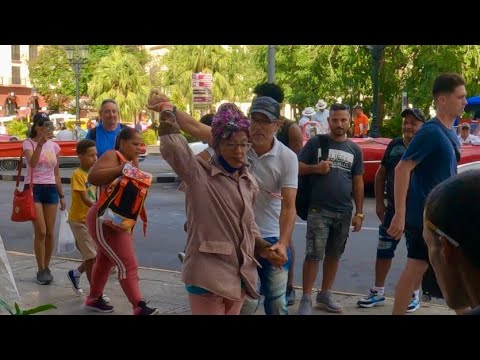
We realized that we hadn’t taken a group selfie yet.
Remember how I broke my glasses when I fell on the Malecón?
Well, the glasses hung on until we were able to find a place where I who could get them fixed. The eyeglass repairman cut the shank and used it to build an entirely new hinge. Because of the U.S. embargo, Cubans have to make things out of whatever materials they have on hand. Below are photos of the repaired hinge and the unbroken hinge.
Judy was feeling better, so she and Ken did their own trip to the artesanias marketplace. They made some major purchases.
For dinner, five of us went to Topoly, a Cuban-Iranian fusion restaurant. I remember liking what I ordered, which was more toward the Iranian end of the spectrum, but what really impressed me was the interior decorating.
On the left there is a Gabriel Garcia Marquez quotation, “You can be just a person [word obscured], but to some people, you are the world.” To its right, Polo Montañes’ quote translates as, “I was able to go up to heaven to bring down a lot of stars.” (Probably loses something in the translation.)
In the next panel, Pablo Picasso says, ” Everyone wants to understand the painting. Why don’t we try to understand the song of birds?” José Martí weighs in with “Exaggerated (grandiose? pompous?”) friends are worse than enemies.” And Bob Marley reminds us, “Every man gotta right to decide his own destiny.”
The final panel is a verse from a poem or song: Where are you my friend? Exactly where are you? Where are you without me? Without me where are you? Come to heal my wound…
To Fernando and Ramón/ Friends forever
That evening, Michael, Ken, Judy, and Camila attended a performance of the Hermanos Abreu, who had played earlier in the week at the Colombian Embassy. These are two young Cuban brothers, whose father is a well-known Cuban musician. Michael thinks they may have potential to become famous outside of Cuba because of their talent.
The next day, we visited the Julius and Ethel Rosenberg Memorial. Dayamí had told us at prior to Danielle’s performance on Tuesday that all Cubans learned in school about their execution after a show trial during the McCarthy era. We had not expected a Cuban in their forties to be aware of this part of U.S. history, since most people in the U.S. are not aware of it.
The writing on their memorial reads, “For peace, bread, and roses, let us face the executioner. Ethel and Julius Rosenberg/ Assassinated 19-6-1953.” We observed the Jewish custom of putting stones on the memorial.
After the Rosenberg Memorial, and a pause to admire a couple of skilled police officers directing traffic at the difficult intersection near the Memorial (during an electrical blackout), we made our way to the Plaza of the Revolution. Fidel Castro and other political figures held rallies with more than a million Cubans attending, particularly on May 1—Labor Day for everywhere else in the world besides the United States—and July 26, an anniversary of the Cuban revolution. Popes John Paul II and Francis also led huge outdoor masses there. The sculpture on the side of the Ministry of Communications is Camilo Cienfuegos, possibly the most popular figure of the Cuban revolution after Castro. The words on the sculpture translate to “You’re doing well, Fidel.”
The sculpture of Che Guevara on the Ministry of the Interior bears the quotation, “Until victory, always.”
The monument to José MartÍ was erected under the regime of the dictator Fulgencio Batista. Significantly larger in scale than the memorial to Martí in Manhattan’s Central Park, shown on the bottom right, the monument generated a number of controversies. Batista displaced people in a neighborhood bordering the plaza to build it and tore down a chapel erected by Catalonian immigrants in 1921. Seems on brand for Batista. Also, I don’t think Martí would have approved.
I think I mentioned that Cuba’s famous antique cars park at tourist destinations. We decided we would splurge and ride back to our apartment in one for Ken’s sake. Turns out every single one of them was booked by what appeared to be a German tour group. So it was a cocotaxi for us, once more.
Since cars have the same impact on me as sports do (aside from Ravi, my Toyota hybrid, who does his best to keep me safe while I’m driving), I wandered across the street. On the top left is the view from where the cars were parked. To the right of that picture, is a closeup of Cuba’s National Library and a billboard with a cut-out of Fidel Castro saying, “Faithful to your ideology, teaching, and example.” The bottom left gives a clearer view of the library’s sign: “José Marti National Library of Cuba.” While he might not have appreciated Fulgencio Batista’s monument, I think having a library named after him would have pleased Martí.
The tree with different colored flowers in three of the bottom photos intrigued me. An internet search revealed its identity as Hibiscus Elatus, or Blue Mahoe. The flowers change color as they mature, from yellow, to orange, to red, to crimson. Artisans prize the wood for cabinet making and carvings.
Later we went to the Doña Alicia Restaurant, which, while recommended in travel guides, served us piña coladas with bad milk. We also had to order using QR codes, which was annoying.
In the evening, Ken, Judy, Michael and Camila went to the Cuba Vive gala at the Karl Marx Theater which featured Cuban musicians performing the best of Cuban music. Afterwards, they went to the National Theater to attend a performance of a Buena Vista Social Club cover band.
The next day we flew home. We got up early, but the flight was late. The airline instructed the airport restaurant to serve lunch to the passengers, but instead of sandwiches or something simple, they cooked full meals, which meant half of the passengers got nothing. On the plus side, the restaurant used compostable eating utensils. The final photo shows a book rack at the Havana airport.
Reflection
As I look back at the January-February trip, I realize I had shut down emotionally for much of it. The meds I am on do a good job of stabilizing my mood, so I haven’t experienced despair or anxiety attacks for a long time. But I also realized recently that it’s been a long time since I experienced joy.
Certainly seeing Cuba deteriorate because of my country’s inhumane policies toward Cuba and its people is enough to depress anyone. I couldn’t forget the USA’s continuing slide into fascism, although part of the reason we came to Cuba included skipping all the nonsense that we knew would occur after Donald Trump’s inauguration. Forgetting my computer at the TSA checkpoint probably didn’t help.
In the coming months, as we resist the evils our government is inflicting on vulnerable people, perhaps we would do well to remember the Cubans we met who, in spite of increasing deprivation, manage to enjoy each other, remain proud of their history, and who always, always, remember to keep dancing.
In the morning, we visited the birthplace of José Marti, which, if we are going to keep up the analogy, is a considerably more modest place than the plantation house where George Washington was born. The sign reads “José Martí was born in this house (on) the day (of) 28th of January 1853. A tribute of the emigration (to) Cayo Hueso –literally, “Island of Bones,” aka Key West. In other words, Cuban emigrants to Key West paid for the refurbishment of Martí’s home. (Those who live there are largely descendants of those who fled the Cuban uprising against the Spanish in the 19th century. Their attitude toward the Cuba is different from that of more recent immigrants. Because of Border Patrol harassment, they seceded from the U.S. in 1983 and became the Conch Republic.
This is the famous picture of Martí dying in battle—usually shown in black and white. Two things that caught my eye: Martí appears to be wearing a suit, and the guy on the other horse holding onto the reins has lost his hat.
Starting at the top left, are photos of Martí’s mother and father. He had seven younger sisters, two of whom died when he was a child. I’m assuming the middle shows the five who survived. If you look at the genealogy tree, you will see that four of them had a lot of descendants. Martí had one, possibly two, children
Bottom left shows Martí as a schoolboy with his teacher. At the San Acleto school he met Fermín Valdés Domínguez, who would become his colleague in revolutionary enterprises. To its right is a photo of María García Granados y Saborío, known as the “Girl from Guatemala” in Martí’s poem. The two met after Martí was already engaged to Carmen Zayas Bazán, whom he compares unfavorably to the Girl from Guatemala in his poems. María died young of a lung disease—or heartbreak—as some would prefer to believe.
Carmen did not approve of Martí’s political activities, chiefly because they didn’t bring in money. She also did not want to live in New York, where Martí was living in exile, so she took their son back to Cuba, raised him to pledge loyalty to Spain, and to despise his father. In my slapdash research, I did not find whether she knew about Martí’s other mistresses. The frame to the right of the “Girl from Guatemala” has a picture of Martí’s son, José “Pepito” Martí Zayas Bazán and his father, when he came to visit Martí in New York.
The last frame shows Carmen with a grown up Pepito. The document shows that he outgrew any sympathies for Spain and fought for Cuba’s liberation. Note the signature of General Calixto Garcia Íñiguez, who fought in three wars for Cuba’s independence from Spain, promoting him to Second Lieutenant. The last photo on the right show refers to his time serving as Secretary of War and Navy.
I was playing around with the edit feature because I wanted to remove some of the glare on the glass. Trouble is, I removed Pepito’s face in the process: sort of like that woman in Borja, Spain, who wanted to improve the “Ecce Homo” fresco.
All in all, most of the museum was photos relevant to Marti’s life. It reminded me of the small civil rights museums we visited in the southern United States, that kept running solely because they had a staff of dedicated volunteers that kept it running.
From the top left, the first photos show the church where Jose Martí was baptized, his baptismal certificate, and a plaque installed at the church by an organization that brings to mind the Knights of Columbus in the U.S. The information on the plaque reads.
In this church of the Holy Guardian Angel on Saturday, February 12, in the year of our Lord 1853, the priest D. Tomas Sala y Figuerola, Cabellan by His Majesty of the Regiment of the Royal Artillery Corps of this Plaza of Havana, solemnly baptized a child – whom he named Jose Julian – who was born on January 28 of that year, legitimate son of D. Mariano Martí, First Sergeant of the Real Perez, native of Santa Cruz de Tenerife, paternal grandparents: D. Vicente Martí and Mrs. Manuela Navarro maternal: Mr. Antonio Perez and Mrs. Rita Cabrera. His godparents were: Mr. Jose María Vazques, and Mrs. Marcelina Aguirre.
In memory of this Christian ceremony, the Association of Catholic Knights of Cuba, a branch of Cuban Catholic Action, place this bronze plaque on the 96th anniversary of the birth of the Great Apostle of Cuba
La Habana, January 28, 1949
To the right of the church frame, is a frame showing the region around the town of Jagüey, where Martí’s father took him when he was nine. The museum doesn’t say whether the parents were having marital problems. Black and white photos, and photocopies of black and white photos have their limits. Check out the handwriting on the letter MartÍ sent to his mother when he was nine! Underneath the Jagüey frame are an article and poem that the periodical, La Patria Libre, published when he was 15.
The frames to the right of the Jagüey frame and below the Cathedral frame represent Martí’s 1870 sojourn in prison when he was 16. He had written a letter criticizing a friend for joining the Spanish army. Accused of treason, Martí was sentenced to six years hard labor. His parents appealed to the authorities, and they banished him to Spain instead.
In Spain and Mexico, he studied and wrote. He taught French, English, Italian and German literature and History of Philosophy at the Central School of Guatemala. He married and returned to Cuba in 1879. After the second “Little War” for Cuban Liberation broke out, the Spanish Government deported him again. From Spain, he traveled to Paris and then to New York, where he would live for the next 15 years. The frame to the left of the large picture of Patria and below the picture of Marti as a teenage prisoner, displays pictures of his time in New York. The labels were hard to read and photograph, but the picture of the Catskills is significant. Martí’s health in New York deteriorated the longer he stayed there. A doctor recommended a retreat to the Catskill Mountains. In that beautiful environment, he wrote his poetry collection, Versos Sencillos (Simple Verses), the most famous of which became the song “Guantanamera.” When I looked at the picture, I immediately thought of the line, “The streams of the mountain please me more than the sea.” Below that frame is one of the only pieces of furniture in the museum: his writing desk in New York.
Martí, along, with other Cuban exiles, put out the newspaper Patria while he was living in New York. They printed it there and sent the copies down to Cuba, where it was distributed furtively. Cubans under Spanish colonial rule often did not receive news of the outside world; they often didn’t know what was happening in Cuba. Patria helped fill that vacuum.
The frame below on the right has pictures of places in Tampa, Florida, where Martí and other Cuban leaders developed their strategy for the third and final war of Cuban independence from Spain. Who knew Tampa, FL was an integral part of Cuban history? In the middle are pictures of his trip to Jamaica, where he was gathering support for the Cuban revolution and the writing desk he used in New York. In the same year, 1892, he founded the Cuban Revolutionary Party.
The final frame shows the route Martí took for the final Cuban War of Independence, from his disembarkation at Playitas Cojobabo to Dos Rios where he died.
So to complete my José Martí/George Washington analogy, imagine George Washington, except as an abolitionist, poet, journalist, diplomat, who had never fought in a battle and died in the first one he did.
After Martí’s childhood home, we went to the Artisans market, where I bought two skirts. I could have spent all day there. They had great food places and all sorts of handmade goods. Judy was still sick, and Ken said the market was just the type place she liked to visit, as well.
It is a truth universally acknowledged that a teenager with a spray can must add penises to figurative street art.
One mode of transportation you see in tourist areas is the Cocotaxi. As you can see, Ken and I enjoyed our ride a great deal. However, the middle seat is extremely uncomfortable unless you are a small child.
In another Cocotaxi trip our driver was a musician in a group that had toured Europe. Having visited Miami, she told us she strongly preferred Cuba. She confirmed our growing understanding that those who are still in Cuba really want to be in Cuba.
We had lunch at an Italian restaurant, Marechiaro, with Camila’s friend, Laura Segura, the music producer and another Colombian friend. I found the photo of the baby at the entrance disturbing.
“Marechiaro” means “clear sea” in Italian, and as you can see from the view through the window, the name is appropriate, or “adeguato.”
Ken and I walked back to our apartment after lunch. Michael went listen to Myrlla Muniz again at the Cuban music museum in Old Havana. In a conversation following the concert, she told him she was excited that someone had come to see her twice. They talked about why someone had come from U.S. to Cuba, politics, and her music. A Brazilian TV reporter who had come to interview Muniz asked Michael some questions in Spanish.
Then Michael went to the Teatro Nacional to hear Brazilian Gaucho (cowboy) music. He and Camila went to a second performance of Los Van Van, who came on stage at 1:30 a.m.
Top picture is a street view of Viñales by David Shankbone. Bottom is a view of Viñales Valley by Fran Hogan. The colors are richer on the Wikimedia pages.
I’ve been writing these blogs based on the photos I took, with Michael helping me fill in details after he reads them. I happened to take no pictures on January 30, but luckily, Dawn took pictures of the trip she, Jose, and Camila took to Viñales.
Michael and I very much enjoyed our trip there nine years ago. I’m more of a small town person, and we loved the artesanias made from what scraps people had available. Below is a camera made of beer cans that we picked up. If you press a lever in back, the lens cap pops off.
Here are some pictures of Dawn, Jose, Camila and the good time they had there. Viñales Valley is a UNESCO World Heritage Site, because of its “outstanding karst landscape encircled by mountains and dotted with spectacular dome-like limestone outcrops (mogotes) that rise as high as 300 m.” (See top picture.) According to Wikipedia, “Karst (/kɑːrst/) is a topography formed from the dissolution of soluble carbonate rocks such as limestone and dolomite.” Note Camila and Jose with their cigars in the bottom right picture. We also visited a tobacco farm nine years ago, and bought some freshly-rolled cigars for friends back home. Today, under the embargo, that would be illegal.
Judy had a terrible cold, and I stayed in most of the day—listening to a book, I assume. In the afternoon, Michael went to a couple afternoon Jazz Festival discussion panels. One about K-pop and jazz included a Korean woman talking about women in K-pop. The next panel—about the impact of women in the music industry—included Laura Segura, the Colombian friend who made it possible for Danielle to come to the Jazz Festival.
For dinner, Michael, Ken and I went to Algarabia, which shows up in travel guides as a place for good, cheap food. Also, the guides say it’s an Italian and Chinese restaurant, which is not how we would have described it.
That evening Michael, Ken and I went to the Bertolt Brecht Theater. They listened to a Portuguese jazz pianist while I enjoyed a piña colada (which was meh). Then I joined them for a performance of the Sacred Funk Quartet, which roots its music in “the ancient sounds of the Yorùbá people of West Africa,” and “honours the rich traditions of West African music, reimagining these timeless melodies for contemporary audiences.” I enjoyed their performance. Ken, a woodwinds specialist, identified an instrument that I thought was a weird-looking saxophone as a bass clarinet.
Just for kicks, I googled “January 30, 2025 Havana” and found the following news item in Cibercuba:
The Cuban regime has strongly rejected the proposal by the United States government to expand the Naval Base at Guantánamo to accommodate 30,000 migrants. In a statement, Havana warned of the “serious consequences” of this measure, emphasizing that it could affect regional stability. Both Miguel Díaz-Canel and Foreign Minister Bruno Rodríguez have vehemently condemned this initiative, describing it as “brutality” and a “disregard for human dignity.”
The next day, we visited El Patronato, Havana’s Jewish Community Center and one of the three Havana synagogues. In the library were an embossed portrait and a bust honoring Max Stone, both of which I thought were Jose Martí. I have included a bust of Jose Marti from the foyer of the center, which is one is which?* Max Stone helped found the the Patronato.
Stone was instrumental in helping Jews from Europe immigrate in the 1930s and 40s. Below is a summary of minutes taken by the Hebrew Immigrant Aid Society (HIAS) in the 1930s. Note that Stone reported on the Cuba’s denial of entry to passengers on the S.S. St. Louis, who were fleeing Nazi Germany. Canada and the U.S. also refused to give the passengers asylum and the ship ultimately had to return to Europe.
Minutes, 1939:3/28/1939, 4/25/1939, 5/16/1939, 6/5/1939, 6/20/1939, 7/25/1939, 8/15/1939, 9/19/1939, 10/19/1939, 11/21/1939, 12/26/1939, 1/23/1940, 2/20/1940Included are: Appointment of committee to ascertain the possibilities of obtaining from the federal authorities diplomatic immunity for HIAS representatives to be stationed in Germany. Discussion of fate of 104 refugees on S.S. Flandre denied entry into Mexico. Commitment to continue transport funds for immigrants to Central and South America. Report by Dr. Max Stone, President of the Centro Israelita de Cuba regarding passengers on the S.S. St. Louis. Report on refugees in Shanghai. Text of cables regarding transport of refugees to the United States. Report on trip to Washington regarding missing person searches in Poland. Report on committee meeting to discuss HIAS participation in 1940 United Jewish Appeal. Appointment of Israel Bernstein as HIAS representative in Lithuania. Report on opening Miami office. Appointment of Milton Goldsmith, director of the Joint Relief Committee in Havana, as HIAS-ICA representative in South America. Report on meeting with Alexander Qumansky, Soviet ambassador to the United States.Minutes of the board of directors, January 21, 1936 – September 25, 1944, Reel: MKM 25.2, Folder: 9. HIAS Board of Directors and Steering Committees, RG 245.1. YIVO Institute for Jewish Research.
Hella, the vice-president of the Jewish Community showed us around, and the President, David, also stopped by to talk to us. The community celebrated its 100th year anniversary in 2006. On the wall of the Center’s large, all-purpose room, were pictures of the hostages that Hamas kidnapped on October 7. There were also photos of their youth who had competed in Israel’s Maccabiah Games and who had worked on humanitarian projects with Proyecto Kesher.
We exempted ourselves from State Department’s travel ban by giving medical supplies to Hella. She was especially happy to see the thousand dollars worth of colostomy bags we brought from a generous Rochester donor, because some members of their congregation use them. Tourists? Not us!
In the foyer, we saw a framed display of multiple snapshots of famous people who had met with people from Havana’s Jewish community, including the Pope and Fidel Castro. But they obviously did not compare to the visit that Stephen Spielberg made to the Center.
I wasn’t sure why they had old newspaper ads framed on the walls of the foyer, but when I look at them closely now, I see they must have been businesses that members of Havana’s Jewish community had owned.
This picture wasn’t the right size to fit in the image gallery of the Jewish Community Center above. This stone was also in the foyer.
The sign says,
This is one of the stones of Clodno Street in the then Warsaw Ghetto. One of them remains in the Synagogue of the Hebrew Community of Cuba, and the other is in the Santa Clara Cemetery. Both pieces serve as a historical reminder of the time and place where the terrible events of the Holocaust occurred. This is a donation from the “Holocaust Memorial Museum” Washington DC.
In this way we share the commitment to education and remembrance of the Shoah.
After the Center we went over to the Beth Shalom synagogue, which belongs to the Conservative Jewish denomination tradition, and Hella answered more questions.
After leaving the synagogue, we went to Dawn and Jose’s rented B&B apartment to celebrate Jose’s birthday with cake. The U.S. Embassy lay directly across from their balcony. None of us reported Havana Syndrome at the end of the day. On the way to the Hotel Nacional we passed the Office of the Jose Martì Tribuna AntiImperialista Plaza (Pictures of the Plaza to come later.)
One sign of the Kingdom of God unveiling itself on earth will be when countries that colonized Africa, the Americas, and Asia also have anti-Imperialism monuments and plazas.
Hotel Nacional
The National Hotel wants you to know about ALL the famous people who have stayed there, including sports figures, celebrities, actors, musicians and and presidents. I didn’t see a real pattern to the notable persons, unless it was by date. For example, Paris Hilton is on the same framed display as Andrew Cuomo and the Prime Minister of Jamaica.
The room of photos was so crowded the establishment even hung some of the framed ensembles from the ceiling. I have outlined Pete Seeger in a yellow circle, because he was the only one I really cared about.
In the foyer of the hotel, they had a display of employees who had lived to the age of 100 or more, which I thought was cool. They also had a display of the rooms in which notable people had stayed. The establishment had decorated the outdoor area for Chinese New Year.
View of the Hotel from the outside and the classic cars parked across the street.
The graffiti we saw in Havana wasn’t quite as orchestrated as the street art we saw in Bogota, but these examples were still impressive.
Havana’s AfroCuban Neighborhood
After the hotel, we headed over to Calle Ejon de Hamel, the center of AfroCuban culture in Havana. On the way, we met an AfroCuban couple, who I’d say might have been in their 60s or 70s. It was hard to tell. Let’s just say they were a vigorous pair. When we told them we were heading to the AfroCuban neighborhood, they said they lived nearby and offered to show us around. This warmth and hospitality I should say, is not uncommon in Cuba.
It turns out that they run a little center for AfroCuban culture in the neighborhood. As we walked toward it, they pointed out what the art on the walls of the neighborhood—and ALL the walls were covered with art and poetry—signified.
The neighborhood demonstrates how much Cuba values the arts. Much of the visual art had to do with AfroCuban religions, the primary one being Santería, but Palo Monte, and Abakuá are also Cuban religions rooted in West African traditions and syncretized with Catholicism. I could have sworn I had a picture of Judy sitting in a chair specifically intended for menopausal women—there’s a god for that—but I can’t find it.-
One new thing I can do with this upgraded operating system is copy text in a photo, and then paste them into another application. You have to do some cleanup in the paste, but it’s useful. Here’s the first example of poetry on the wall of the AfroCuban neighborhood. An actual Spanish translator who understands poetry, of course, would do a better job
I want to mutilate you, black shade of the unknown, I want to laugh in your claws of intense blue, of distant sea. I want to sit in your shadow and continue onward, I want to describe you in spaces so that you may be known. You are the inert pace of distant time, You are the light and song that calls more, but I cannot describe you. Like my hand, you escape like water between small stones. What is your enigma at the far front? What is your back that smiles inertly? I know you return every night.[…] morning
After I’m dead I neither want an apology nor gifts. I come from a hidden reality to an open reality so that you know me
Anonymous
The top two ruminations by Salvador say,
“All that sell love are as miserable as They who buy it.”
Salvador
“The fish doesn’t know that water exists.”
Salvador
I actually was able to translate those myself! Here’s an AI translation the anonymous poet below Salvadors:
It is not my street It is not anyone’s street It is our street Compelling Spirit of a single mystery that emitted colors one morning to conquer With its old man it wins the battle At the door of your mantle I wrote your name As distant as history Distant land, stone, fire, and water here is the gift so that you Learn Because profane is the one who Hides the true word
Finally, I was haggling with this boy on the left about how much it would cost me for him to move away from the wall, when an older gentleman ordered him to get lost. The wall appears to be a tribute to the art in the neighborhood, and in particular, the artist Salvador. I realized that the problem with my comprehension toward the end wasn’t the fault of the AI translator. The author was using academic art jargon. I have linked some of the jargon-y words to definitions.
Don Fernando Ortiz To the neighborhood of Cayo Hueso To the people of Cuba In this alley of Centro Habana named Hamel, on April 21, 1990, the first mural was born in the public street dedicated to Afro-Cuban culture. Iremes, Orishas, legends of black gods in the great thicket of the jungle and the woods to say: Today I have my first public temple for everyone, where the branch covered the bare body to ward off the evil that suffers, the evil that ends. To fill with colors those mute and bare walls that waited so long, and with my time, which is mine, just as from yours you are the owner, To give through the sentiment of being to be a trace of the known without fragments of words. Songs of my drums, songs of my white garments. Without being a sentence, I am word by word. I am the one who painted walls and sent messages at dawn. Forgive me critics and intellectuals, I speak my word. I seat the beggar in the chair, I embrace the frank smile. I enjoy the juice of my blood, which is African blood, but I also breathe deeply to fill my life and soul with a Spanish smile that bore mixed-race blood. Spirits of the day and the consecrated night, may all be present to send messages at dawn. The coward flees from the truth because the lie is like him.
The work of Salvador González Escalona exposes the purist equation of a context that now, as a solitary fact, as a historical definition presented as an artistic assistant of a nation of our cultural reality, and as such, becomes a source of knowledge and expression of the social being. It is in this concept that his artistic work makes tangible demystifying aspects of an analogy and increases the gnoseological value. It’s worth noting that, as art, it also refers us to a form of knowledge that challenges to stretch its own boundaries in time.
Salvador’s art shows us not only all the techniques and styles of the old art of the Islanders, clear santero houses where the most elaborate and beautiful ceremonial pieces are crafted. Salvador, with intelligent function, has refined these techniques and created, on a protean platform, his own style. *Miguel Barnet The Afrocuban Spirit as It Is Called,” Miguel Barnet
Despite knowing other painters and visual artists in general who have ventured into this field, Salvador has not been influenced by the superficial and deceptive snobbery or by the aesthetic intellectualism of the West in approaching these topics from the outside. Or “from above,” that is, from the analogical picturesque view that might exist between Haitian voodoo and the rituals that occur in Cuba, treated from a European capital or from the morphological aspect of Dahomeyan cloth or the pictorial decoration of the Yoruba widely publicized through art books, to extrapolate to Cuba for the simple fact of being “African” and thus being in international fashion. Jesús Guanche 1986**
Although certain corners of Havana’s neighborhoods were heaped high with rotting piles of trash, if someone painted, “No Trash” or “Don’t throw trash” on a wall, Habaneros obey the order scrupulously. I was so intent on getting the trash warning, I didn’t notice that the gang graffitied next to it were holding band instruments until I prepared to upload the photo.
In the evening, we finally reached our Apex Event—Danielle singing at the Havana Jazz Festival. I’ve never seen her give a bad performance, and that night continued the streak. She got a ticket for our cook/cultural advisor Dayamí, and we had some time to sit in a place outside the concert hall that served drinks and snacks. I had a reasonably good 5 minute video of Danielle singing, “Poor Man’s Pain,” which followed two bad attempts of me learning the video feature on my phone. Turns out, WordPress can’t handle a 5 minute video. Anyway, here’s a video of Danielle singing “Poor Man’s Pain,” at NPR’s Tiny Desk Concert.
While we were in the room where Danielle was singing, Dawn thought she saw Camila and motioned her over. Turns out it was a Turkish diplomat who wanted an introduction to Danielle, and they talked about Danielle coming to Turkey.
A pianist from Azerbaijan performed immediately after Danielle in the same room. A few peoplein our group decided to stay.
In the evening we went to a famous restaurant in Havana: San Cristobal Paladar. The Obamas ate here when they visited Cuba. The manager had a lot of their photos prominently displayed. Although we had made reservations, the manager made us stand for a long time while an empty table fitting the size of our party was clearly available. Then the wait for our food (at that very table} was also long. Truthfully, we were not all that impressed. The piña coladas were meh. I ordered fried lobster, an appetizer, for my entree, but they brought it out early anyway. However, it was delicious. Imagine eating a a basket of fried clams, but it’s lobster. Caribbean spiny lobsters are a lot smaller than Northern lobsters, but also cheaper.
Outside of San Cristóbal PaladarOne of its dining roomsCaribbean Spiny LobsterWhile we were waiting. There were more than a few pictures of Obama and his familywhile we were waitingWhile we were waiting
After a long day, we went home to sleep
*The one in the middle is Marti, who sits in the foyer of El Patronato.
The previous night, we all went out with Danielle to something resembling a diner with Cuban food. Think Denny’s with less decor. I just wanted something cold to drink. “Suero helado” was an item on the menu. We all knew the second word meant ice cream, but even Camila, a native Colombian Spanish speaker, didn’t know what “suero” was. The server behind the counter explained that it was a milkshake, which sounded good to me, even though the only ice cream they had was rum raisin. Later on, as I was running through Spanish flashcards, I found out that “suero” could also mean “saline solution.” I looked it up, and the Latin root of the word is “serum,” which also means “whey.” Dawn or Jose took the pictures below.
The next morning, Danielle came over to our place for breakfast and we had a leisurely conversation with Dayamí, our cook. She told us she had taken part in a torchlight parade to honor Jose Martí the previous evening, and has been doing so annually since she was a university student. Then Danielle, with Camila as her translator and erstwhile “manager” in Cuba, went to a press conference with local Cuban media.
The rest of us went to the Martin Luther King Center and the Ebenezer Baptist Church, which are located in the outlying neighborhood of Marianao. Pastor Rudiel ,who shepherds the church, met us at the Center and gave us a tour. He told us that both the church and the center were founded to honor the legacy of Martin Luther King, Jr. and purposely built in a poor, Afro-Cuban neighborhood. However almost everyone who attended in the beginning was white. So they looked for ways to engage with the community. They announced that people could fill their buckets with clean, filtered water every evening between 5:00 and 9:00. They also began offering milk for children, and opened a small pharmacy where they passed out medicine, bandages, and other basic First Aid supplies. Their church now reflects better the community in which they live.
Pastor Rudiel told us the minimum wage is $5 in Cuba, and the government no longer provides a basic food supply of rice, beans, flour, and oil as it used to. Cubans who work in the private sector earn much more. His own salary is $30/month. A lot of people get by, he said, because their workplaces offer breakfast and lunch. I thought, but what about their families?
Networking is a big part of the center’s work. They have contacts with peace and justice-promoting Evangelical organizations all over Latin America, including Justapaz , who first invited Christian Peacemaker Teams to work in Colombia.
In the room where we met, there was a wall hanging from The Protestant Center for Pastoral Studies in Central America (CEDEPCA) (in the picture with Gandhi) that offers God’s blessings to the center. The red sign says, “On the road home, I want to be free, not brave.”
After the meeting we gave the Center’s pharmacy the medicine and bandages we brought from Rochester. U.S. tourists cannot visit Cuba. they must have reasons. Unfortunately, the Trump Administration is implementing a new restriction that tells Cubans who have residency in the U.S. but not citizenship may go to Cuba, but will not be able to return. Bringing in the medical supplies counted as “support for the Cuban people.”
12 categories of authorized travel to Cuba are: family visits; official business of the U.S. government, foreign governments, and certain intergovernmental organizations; journalistic activity; professional research and professional meetings; educational activities; religious activities; public performances, clinics, workshops, athletic and other competitions, and exhibitions; support for the Cuban people; humanitarian projects; activities of private foundations or research or educational institutes; exportation, importation, or transmission of information or informational materials; and certain authorized export transactions.
U.S. Embassy in Cuba https://cu.usembassy.gov/services/traveling-to-cuba/
Unfortunately, the Trump Administration is implementing a new restriction that tells Cubans who have residency in the U.S. but not citizenship may go to Cuba, but will not be able to return. When we visited the Center in 2016, one wall of the cafeteria was full of T-Shirts from solidarity groups. We added a red and black T-shirt from Metrojustice, a Rochester Non-Profit. Unfortunately, due to the Covid pandemic, they had to destroy the T-shirts.
Last four pictures taken by Dawn and/or Jose.
Some pictures from inside the Ebenezer Baptist Church
We had a restful afternoon at our apartment.
In the evening, we went to Antojos, a good, but pricey, restaurant in Old Havana. Danielle’s guitarist, Garrett, and photographer, Ray, joined us. The piña coladas were on point. Most of us went back to our apartments. But Ray, Danielle, and Michael went to Havana’s coolest Hip Hop place and then met Camila at an invitation-only performance of Los Van Van, Michael’s favorite Cuban musical group. Laura, a Colombian music promoter who had helped Danielle get the invitation to sing in Cuba, got tickets for Michael and Camila. Danielle and Ray got tickets because of Danielle’s status as a performer at the Jazz Festival. Los Van Van started their set at 1:45 a.m. When Michael, Ray, and Danielle left at 3:00 a.m., Camila was still dancing.
The next morning, we devoted ourselves to sightseeing. A straight 20-minute walk down San Rafael Street took us to the Old City of Havana, with the statue below at the end. Art permeates Havana. Cuba promotes music, visual art, and dance in schools from a young age. From what I have observed, artists appear to be more revered than sports heroes. In 2021, their call to the government for more freedom of expression caught the regime and much of the world by surprise. It also resulted in some of the artists serving prison sentences.
Our next stop was a visit to the former Presidential palace of Cuba that the government turned into the Museum of the Revolution in 1973 and a National Monument in 2010. But first, Ken got a chance to check out some of Cuba’s famous vintage cars:
The Plaza we crossed to get to the palace was the first place we encountered begging—she was an old, clearly malnourished woman. I don’t remember seeing people like her during our first trip to Cuba nine years ago.
The Presidential Palace
Presidential palace
Because one of Cuba’s frequent electrical blackouts had struck that day, the museum inside the the palace had no lights. Therefore, the following photos are dimmer than I would have liked, even with all the fancy adjustments on my iPhone. All the photos have English translations that you can read if you click on the photos, as do the next set of photos. To sum up the attitude of the museum toward these reminders of pre-revolutionary times, consider the comment on the office of the Presidents of Cuba between 1920-1965: “In this place, the most anti-popular, proimperialist (sic) and macabre decrees and laws that governed the national scene before 1959 were endorsed.”
Resistance
The next set of photos (below the picture of George Washington) chronicles the history of resistance in Cuba from the time of Indigenous people resisting Christopher Columbus and the conquistadors to the Cuban Revolution in the 1950s-60s. The three Indigenous groups who lived there at the time of Columbus’s arrival were the Taíno, Ciboney, and Guanajatabey. By 1544, Spaniards had decimated the native population from a conservative estimate of 112,000 people to 893 people, according to a count by Bishop Diego de Sarmiento. Criollo first referred to Spanish people born in Cuba, then to those who had intermarried with Indigenous and enslaved African people. They rebelled against the Colonial Government three times in the early 18th century, and resisted the English invasion during the Seven Years War or the First World War , as Churchill called it. And as long as we’re going to reframe things, it was a time when the English Crown authorized the British Navy and English privateers to be pirates and steal gold from Spanish ships that the Spanish had stolen from the New World.
From the time the Spaniards introduced slavery to the Island in the 16th century, enslaved people had probably rebelled against their enslavers, but from 1763 with the wealth coming in from sugarcane and coffee plantations, it had become a necessary cog in the capitalist enterprise, and insurrections became frequent. In the early 19th century social critics like Padre Felix Varela and Jose Saco spoke out against slavery and other social injustices.
Now we get to Jose Martí.
Imagine George Washington. If you can’t, I have provided Gilbert Stuart’s portrait to the left. Now, imagine that George Washington was a sickly abolitionist, journalist, poet and writer, who fought and died in the revolution that freed Cuba from colonial rule. If you can imagine George Washington comprising all these elements, you will understand what Jose Martí represents to the Cuban people.
Interestingly, a lot of of the Cuban intellectuals like Varela, Saco and Marti spent years in New York City, writing in exile.
The Ten Years’ War was an uprising was led by Cuban-born planters and other wealthy natives. On 10 October 1868, sugar mill owner Carlos Manuel de Céspedes and his followers proclaimed independence. This was the first of three liberation wars that Cuba fought against Spain, the other two being the Little War (1879–1880) and the Cuban War of Independence (1895–1898). The painting behind the velvet rope represents the Constitutional Assembly of Guáimaro, in which representatives of areas that joined the uprising met and decided what they wanted their government to look like. One decision that they overwhelmingly agreed upon was the separation of civil and military powers with the latter being subordinate to the former. They elected Céspedes as president of the assembly and reconstituted themselves as the House of Representatives.
From 1929 to 1933, the Cuban people rose up to resist the dictatorship of dictatorship imposed by Gerardo Machado, the “Donkey with Claws.”
In 1952, former president Fulgencio Batista overthrew the government in a coup. While some criticisms of the Cuban government’s human rights abuses since Castro took over in 1959 are legitimate,* we do not typically hear about the human rights abuses under the Batista’s regime. The death toll of dissidents killed under his regime ranges from hundreds up to 20,000—the uncertainty lying in the fact that many were disappeared by Batista’s security forces and never heard from again. Hundreds were tortured to death. Batista also had warm relations with U.S. organized crime personalities, like Meyer Lansky and Lucky Luciano. Together they turned Havana into what playwright Arthur Miller called, “”hopelessly corrupt, a Mafia playground, (and) a bordello for Americans and other foreigners.” For all these reasons, Castro’s rebels had broad popular support when they toppled Batista’s government. Some of those who fought with him and were hoping for democratic elections were later dismayed when the elections never took place. And of course, it did not matter to the Cuban elite that Castro’s reforms helped the great majority of Cuban people become better educated, healthier, and food-secure after these elites fled the country.
Amnesty International, in its reports on the state of human rights in Cuba, will describe the harassment and imprisonment of dissidents.† But it usually includes a paragraph on the U.S. embargo on Cuba:
Amnesty International has repeatedly called on the US government to lift its embargo, as it is highly detrimental to Cubans’ enjoyment of a range of economic, social and cultural rights, such as the right to food, health and sanitation. The World Health Organization, UNICEF and other UN agencies have reported on the negative impact of the embargo on the health and wellbeing of Cubans due to the lack of access to medical equipment, medicines and laboratory materials produced under US patents. Although the Cuban government is primarily responsible for respecting, protecting and fulfilling human rights in Cuba, Amnesty International believes that the US embargo has helped to undermine the enjoyment of key civil and political rights in Cuba by fuelling a climate in which fundamental rights such as freedom of association, expression and assembly are routinely denied.
“Cuba: Human Rights at a Glance.” Amnesty International, 17 Sept. 2015, https://www.amnesty.org/en/latest/press-release/2015/09/cuba-human-rights-at-a-glance/
IIn other words, the embargo creates a siege mentality in Cuba. If the U.S. lifted the political and economic pressure, as it began to do under the Obama Administration, the government would feel more comfortable expanding some democratic structures that are already in place.
Also, Cuba, Laos, and Vietnam are the only Communist countries left in the world. (China has vast wealth disparity amongst its citizens, which means it cannot be Communist, anda fascist monarchical clan rules North Korea.) The U.S. trades with both Laos and Vietnam. It punishes Cuba only because it can.
La Colmenita
In the evening we went to attend a performance of La Colmenita, which I mentioned in the last post. I probably should have looked up how to take pictures in the dark with my fancy iPhone camera, but these were the best I have, after a lot of editing. “La Colmenita,” means “the little beehive” which explains why the children dress in bee costumes. Founded by Carlos Alberto Cremata, this children’s theater group has traveled all over the world. When Michael and I were here with the Witness for Peace delegation nine years ago, we learned that on their one and only tour of the United States, La Colmenita performed at one of the most impoverished schools in Los Angeles. After seeing the dilapidated state of the building and learning that the school could not afford music or art programs, the children decided to donate the money they earned touring California to that school so the children there could have music and art again.
The performance we attended was dedicated to the ground-breaking Afro-Cuban jazz band, Irakere. It began with all the children singing and dancing on state, followed by a Teen Bee narrator explaining events that followed, with intermissions of Afro-Latin, and Latin Jazz music, including a tribute to Irakere. In the first play, a little girl in a Heidi dress appeared (circled in black below) and watched a procession of animals each claiming that they were the best dancers. After that, a Cuban version of Goldilocks unfolded, with the little girl eating the baby bear’s soup, instead of oatmeal, and lying in his bed. Predictably, the bears came home, a chase ensued, but the play ended with everyone dancing on the stage (the adults sitting on the stage behind music stands were the people who voiced the characters in animal costumes.)
After La Colmenita, we went to Danielle’s Bed and Breakfast to welcome her, and the eight of us had dinner. Judy, Ken, and I went back to sleep. Camila, Danielle, Dawn, Jose, and Michael went to El Floridita, so that a Danielle could listen to the live music—that night, the bar featured a female singer. Michael et al. were unsuccessful in their efforts to convince Danielle to sing
Miscellanea
Other important aspects of the day: A perfect cup of latte and a cart decorated with old newspapers. Roughly translated, the phrase written on the bottom ridge of the cart says, “What a tremendous source of pride it is to be Cuban!”
I’ll close with Jose Martí’s most famous poem, Guantanamera, later turned into a song made famous in the U.S by Pete Seeger.
*A lot are illegitimate. For example, in the first couple of years after overthrowing Batista’s dictatorship, Castro’s government practically eliminated illiteracy. His detractors claim this was a bad thing because the now-literate peasants could read the government’s propaganda.
†But compare this report to some of Amnesty’s reports on places where Community Peacemaker Teams (formerly Christian Peacemaker Teams) works: The West Bank, Colombia, Iraqi-Kurdistan, and the Aegean Islands.
Dancers at La Floridita, one of Hemingway’s favorite bars.
We had several reasons for vacationing in Cuba this year. We had always wanted to go back after our trip nine years ago. Last year, we had stayed at our friend Camila’s apartment in Bogota, and through her got our friend Danielle Ponder invited to the Havana International Jazz Festival. More on Danielle in a minute. We wanted to escape the U.S. the week after Trump’s inauguration, and then there was this factor:
At the time we flew out of Rochester, the Los Angeles fires were raging. I had read that theplot of the movie Chinatownexplained why LA had run out of water, so when I saw it was one of the selections available on Delta entertainment, I decided to watch it. Then I realized that Roman Polanski had directed and had a moment to decide whether my conscience would permit me to watch. I no longer watch media involving Woody Allen, Kevin Spacey, Johnny Depp, Bill Cosby or other abusers. But my curiosity about the politics of Los Angeles water got the better of me. The movie does do a good job of laying it out, but then Polanski adds this ick factor by revealing that Faye Dunaway’s character was raped and impregnated by her filthy rich father, who goes on to kidnap his daughter/granddaughter while the Los Angeles police (who are suitably racist) stand by.
Miami We were fortunate that Michael’s daughter, Beth, married into a family with whom we enjoy spending time and also run an Airbnb room in Coconut Grove. Martha and Rubens are the embodiment of hospitality. Visiting them, Beth, and Eric before we took the flight to Havana was a vacation in and of itself. In the picture below, Rubens is sitting at the end of the table and Martha is to his left. Eric is sitting between his mother and Beth, who is holding their niece. The children belong to Simonette, Eric’s sister, sitting beside Beth. I am sitting between Simonette’s husband and Michael. The owner of the restaurant, who is part of the extended family, took the picture in Medellin the day before Beth and Eric’s wedding.
Back to Danielle Danielle was a public defender here in Rochester who has been having a lot of success with her music lately, including a Grammy nomination for best new R&B artist. She shared about both arenas of her life in a Ted Talk: What music can teach us about justice. Check out her website to see if she might be appearing near you!
Here’s a song from her most recent album, Some of Us Are Brave. She mostly wrote it for black women, but when I heard the first stanza recently, I thought it could apply to the times we are facing in the U.S.
Arrival So my plan for the time in Havana involved working on this blog and getting some other writing done, while the rest of our group was attending concerts. Unfortunately, I left my laptop at a TSA checkpoint in Miami. I had asked for a wheelchair escort—not because I can’t walk, but because standing for any length of time is agony, and I think having two people minding my luggage through security meant the laptop didn’t get get picked up. Also, once I was through the line I focused on getting my money belt and back brace on.
When we arrived in Havana, I looked for the drug-sniffing mutts I had seen last time. Although I couldn’t see them, I heard them yapping away across the other side of the airport. Our fellow travelers, Ken and Judy said that the dogs they saw appeared to be beagles and beagle mixes. The picture to the left appeared in a 2014 issue of the Havana Times.
I’ve reflected on the difference it makes when Security is only interested in dogs for their sniffing abilities. I’ve come to believe that those who use German Shepherds want to intimidate people as well.
Below is our Bed and Breakfast in Havana. Our host had told us that we would have to go up 60 steps. Michael chose this instead of a high-rise with an elevator option because the electrical grid often fails in Cuba. Truthfully, I almost passed out every time I got to our apartment. Fortunately, on the first day, we only needed to get our suitcases up one floor. It was a beautiful old apartment—dense, dark wood floors and molding. Our rooms were comfortable and airy.
From the B&B, our airport driver took us to the Cuban Cultural Office to pick up our job festival passes, program booklets, and T-shirts. Because of the U.S. embargo we could not purchase these things in advance, but our friend Camila was able to put everything on her Colombian credit card before we traveled there.
From the ticket office, the driver took us to the La Paila Fonda. Many of its chairs were hanging swings. And here began the non-alcoholic piña colada quest for Michael and me. If I remember correctly, we got off to an auspicious start here.
Ken and Michael have known each other for 50 years, having met at the JCC summer camp–which did not make Jewishness a criterion for attendance. Ken is a musician of several wind instruments and recently retired from teaching music in the public schools for four decades. Judy retired two years ago from her job as Activities Coordinator at Jewish Senior Life in Rochester and, like me, is a gargoyle aficionado, among other things.
After lunch, the driver took us to the box office of the Karl Marx theatre to buy a ticket for me to a performance of La Colmenita. More about that later. I had to get a separate ticket, because I did not have a jazz festival pass. Yes, among my many flaws is not liking jazz. I respect it, in the same way I respect opera acknowledge the musicians are talented, but it kind of bores me. I like singers who incorporate jazz, like Steely Dan and Bruce Cockburn. And I like tuneful jazz from the thirties and forties, but well, a pass to the festival would have been wasted on me.
The cost of the ticket was 50 Cuban pesos, which was equivalent to U.S. 17 cents at the unofficial exchange rate. The great majority of people who attended the Jazz Festival were not Cuban because Cubans could never afford ticket to it, but La Colmenita was for the people.
Afterwards we rested at our B&B, Michael went to the airport to pick up Camila. We had stayed with Camila when we were in Bogota last year and thought we would return the favor by inviting her to stay with us in Havana and attend the Jazz Festival with us. Originally, Camila had planned to fly from Bogota to Colombia via Panama, which was cheaper than a direct flight. After Trump threatened to invade Panama, she made arrangements to fly directly to Havana.
El Floridita In the evening we walked around looking for something to eat and at the entrance of Old Havana saw El Floridita, which a 1953 issue of Esquire Magazine dubbed “one of the 7 most famous bars in the world.” The Catalan immigrant bartender Constantino Ribalaigua Vert invented the daiquiri there, but we also found the non-alcoholic piña coladas superb. Most of its fame comes from its association with Earnest Hemingway, who patronized it frequently. Even after he moved out of the city to the country (which Michael and I visited last time we were in Cuba), he would still drive into Havana to visit the bar often. Below is a picture of him with Fidel Castro.
We all agreed the band was stellar. The electric violin and guitar were miked, but the singer was not. He had an extraordinary voice. I wonder if he had studied opera. Adding to the entertainment were people who got up to dance in the meager space around their tables or just in front of the band. Most of them were very good. I later asked a Cuban whether men have hip problems there, given how fluid their dancing is. He said hip and back problems are rare. Camila would later join us at the bar. Dawn and Jose arrived after her. Dawn is an American Sign Language translator and has volunteered at the Gandhi Center in Rochester, where she met Camila when she worked there years ago. Jose works with a non-profit that advocates for the release of elderly prisoners and supports those who have left prison. Cuba was the first trip he had taken outside the country.
Danielle had not yet arrived in Cuba, but we thought we would walk by her B&B to see where she was staying. Jose took this picture so we could prove to Danielle we had shown up.
After our street art tour in Bogotá with Camilo, I kept my eyes open for street art in other places we visited. Santiago also has a notable street art community and now I kind of wish we had taken a graffiti tour there. The first street art we saw was actually an advertisement for an Amazon Prime program! The yellow owl was across the street from a cafe where we got some lunch. In my blog post on the ESMA Museum of Memory in Buenos Aires, I talked about the meaning of “Presente.” So when I saw the graffiti about Luisa Toledo, I looked her up. The Pinochet regime killed three of her children, and she became involved with liberation struggles against the dictatorship. She also advocated for the Mapuche Indigenous people, who were seeking territorial autonomy. Her family put out the following communique when she died.
To the national and international community To the women, the children, the elderly, and the honorable men of this land To the political prisoners To the clandestine ones who plow through rebellions To the Mapuche people To those who fight To the residents of Villa Fráncia To the combative youth: It is with deep sadness that we inform everyone of the death of our beloved comrade Luisa Toledo Sepúlveda. Surrounded by her most intimate family circle, she passed away peacefully in the privacy of her home on the morning on Tuesday, July 6. On this cold July morning, we were proud to be able to say goodbye to an unwavering, timeless, and essential woman. And although Luisa leaves us physically, her legacy has deeply penetrated the history of those who fight beyond the borders of this territory called Chile. With incalculable courage, Luisa fought for a justice that she never received after the murder of her children, Eduardo, Rafael, and Pablo, a pain that made her decision to fight unbreakable. Today will be marked as a before and after with the indelible mark of Luisa. Luisa, mother of the fighting youth, will continue to be an unfaltering beacon for those who fight. Let it be known to all the traitors, syncophants, and those who remain comfortable during moments of revolt, that her tenacity and consistency will remain the trailheads for new paths of struggles and rebellions in every poor corner of this world. Compañera Luisa Toledo Sepúlveda, Present Villa Francia, July 6, 2021 #FightlikeLuisa #MotherOfThecombatantYouth #LuisaLives #EveryDayAYoungCombatantisborn #VillaFrance #FreedomToThePrisonersoftherevolt
The graffiti “RP Global killed the black woman” probably refers to the death of Macarena Valdés, a Mapuche Indigenous woman. The Chilean authorities arrested her for trying to prevent the multinational company, RP Global, from stringing high voltage power cables through her community. The one beside it says “War to the state,” with an anarchist logo beside it. Below, we have poetry. The first, blue against a cream background, reads “Soul trash/We collect your fears/Old loves and bad luck/ Shake it off here.” Not sure of the poet’s last name, but the first is Pippi. The same poet (Pippi Morís?) wrote in white on blue, “Assembly of a whole being/I feel cold, never afraid/My soul is conscious/Vibrating along.“
Victor Jara was an internationally famous Chilean folksinger and university professor tortured and killed by Pinochet’s regime. Dragged into an indoor stadium, soldiers smashed his arms and systematically broke his fingers. Then they taunted him to play his guitar. The Spanish under his portrait reads, “With the force of song.” To his right, is a poster showing an indigenous person kicking a soldier, with the phrases, “Soldiers go back to your quarters.” On either side is the quotation, “So that memory does not exist only in September,” recalling the September 11, 1973 coup.
Below that, you’ll see a poster about Indigenous people that has been ripped off the wall. To its right, the poster says, “With death and torture, Democracy is still being built. Sowing terror to defend your interests and continuing to profit from our necessities. To 50 years of the coup. Self-organization,[obscured], and Direct Action. The encircled A and the star represent Anarchists and Communists. I don’t know what the third logo represents. It does not appear to be the flag of Chilean socialists. Because of its proximity to the Indigenous poster, and because of how governments treat Indigenous people in the Americas, I think the two posters may relate to each other. I don’t know what the three-eyed person means in the street art below that, but the words say, “State of Rebellion before the Oppressor State.”
In the last row, we see graffiti dedicated to the struggle of the Mapuche people. “Mapuche” means “people of the land” in their language, and “newen” means “force.” The small posters stuck on the painting of an arch call for justice in the murder of Annibal Villarroel, a working class protestor shot by police lieutenant Joaquin Muñoz Vasquez in 2020. Alex Nuñez was a 39-year-oold repairman who was trying to get home under military curfew. Police chased him and and beat him up. He died later in the hospital from his injuries. Under his image, someone has written, “They fell fighting for [human/civil] rights.” And below that, someone has written, “Arise those who fight (or struggle.”). The writer turned the tail of the q into a cross. On the picture to the right, the graffiti says, “For Communism, for Anarchy, let’s go on the offensive.”
I thought a couple of pieces were so striking I wanted to feature them. First up was the adaptation of Pablo Picasso’s Guernica, which was his response to the 1937 bombing of the city of Guernica by fascist Italy and Germany. The artist of this mural used Picasso’s motif to describe the crackdowns on protests against inequality that began in 2019 and continued into 2020, until Covid-19 ended them. One demonstration on October 25, 2019 had more that 1 million people show up.
We stopped in at the Gabriela Mistral Cultural Center , which was closed for the day, and saw this mural. I would have loved to have had a Chilean historian or art expert explain it to me. I did a Google Lens search, and someone said this mural is called “Free Africa.”
I saw a mosaic on the side of the building—obviously installed when the center was built—that I initially thought was a picture of the Catholic Church bringing enlightenment to the savages. However, on closer inspection, I see that it’s a depiction of Gabriela Mistral, who herself received little standard education because she grew up in poverty. She advocated for Indigenous, poor, and working-class children to have the same right to education as other Chileans. Below are a couple of other murals from the center. The quotation above and below the frame in the picture to the right means, roughly, “As the streets expand over everything, the countryside shrinks. If the countryside dies, the city doesn’t eat.”
International Women’s Day Street Art
The evening we landed in Santiago, our driver told us he could take us only within three blocks of our rented room because of the International Women’s Day March. Dragging our luggage all that way was not fun, but participants in the March sure left a lot of interesting graffiti and posters behind. The top photo is slang that means, roughly. “Legal Abortion. Never with the police. Always with the whores.” The three unobscured graffiti postings below it read, “No is no,” “How many have to die in the name of false love,” and “Believe your daughter.” The posters give statistics:
In Chile, women work double the hours of men each day to take care of children and other dependents
At a global level, women work more than 76% of the unremunerated jobs.
1 out of 2 women of working age do not participate in the workforce, while 70% of men in the same position do.
Women in Chile receive $21.7 less that men do.
Did you know that only 7.5 public monuments are about women?
9 out of 10 women have been harassed on public transport.
Did you know that only 5.5% of the almost 100 million streets in Chile are named after women?
In Latin America, 49% of women have taken a break of 6 months or more from their work.
In Chile, 2 out of 5 women cancel trips within the city because the situation is too insecure for them to go there.
The posters in red depict the pictures of young women that the Pinochet junta regime kidnapped and who are still missing. The poster of the little girl in her school uniform jumping the turnstile reads, “Against the disposal and the violence of the colonial, capitalist, patriarchy. We resist for life. We march for transformation.” The final picture, bottom right, says, “I am the artist. NOT the muse.”
Palestinian Solidarity Street Art
As I’ve mentioned in earlier blog postings, we saw evidence of solidarity with Palestinians in all the countries we visited. In South America, only French Guiana does not recognize the State of Palestine. In Santiago, however, support for Palestinians seemed omnipresent. I remembered a friend in Bethlehem telling me in the 1990s that there were more Palestinian Christians from Bethlehem in Santiago, Chile than there were Palestinian Christians in Bethlehem. I also remember his taxi driver friend telling me he didn’t want to emigrate, but the Israeli closure of Bethlehem had tanked the economy, and he had family in Santiago who could help him start a new life there. Nearly half a million Palestinians live in Chile today.
From the top left: I took this picture from a car, so it’s not the greatest, but you can see the Palestinian woman wearing a keffiyeh (incidentally, some Palestinian Muslim women do wear keffiyehs—usually as a political statement, but it’s unusual. They prefer more fashionable headscarves. Keffiyehs are for working-class men.) On the top right, the posters say, “Together in the Struggle,” and feature an Indigenous woman, a Black woman and a Palestinian woman. Bottom left is a stencil showing a Palestinian woman holding a baby, with the statement: “Patriarchy equals genocide.” The next poster is a lithography saying, “Free Palestine.” (Below that is a poster saying “Milk is rape.”). Hanging on the same screen are posters saying, “No+Genocide,” with abstract figures in the colors of the Palestinian flag. On the bottom right, the top slogan says, “Palestinian Woman Resist.” (Below, in red, it says “Woman, light your fire” and, in black, “To abort is a right.”)
Valparaiso We have a friend in Rochester from Chile who encouraged us to go to Valparaiso, because she doesn’t like Santiago, and thinks Valparaiso presents a more beautiful side of Chile. Valparaiso is indeed a picturesque city. Valparaiso has Latin America’s oldest stock exchange, the continent’s first volunteer fire department, and Chile’s first public library. El Mercurio de Valparaiso is the world’s oldest Spanish language newspaper still in publication. UNESCO has called Valparaiso a World Heritage Site because of its historic importance as a seaport where ships stopped on their way to and from the Straits of Magellan before the Panama Canal was built.
Below is our lunchtime at a restaurant that our friend from Rochester recommended for the view. A driver in Santiago whom we liked agreed to take us to Valparaiso and then to the airport to catch our overnight flight. So of course, we invited him to eat with us. I ordered the dish our friend had recommended, the seafood soup. Good choice.
We took a walk into the center of the city before we went into its hills. This statue of the Greek god of justice, Themis, appealed to me. I think it was her swagger, with the hand on the hip. The plaque reads, “Themis, goddess of justice, ‘Figure and features of a young woman, a hard and fearsome look. Very vivid shine in her eyes, neither submissive or threatening, but with the dignity of a certain venerable sadness.'”
We then went up to the upper levels of Valparaiso on a funicular. The city has 17. Basically, they operate on the principle of counter weights. As one car goes down, it pulls the other one up. The pictures show the view from the top.
We thought we were seeing more Chilean street art in this hilly neighborhood, but the painter of both pictures has a Colombian Instagram address. I am not sure what the picture on the right signifies. The picture on the left shows Chile being drained of its resources. I am guessing the octopus pig is multinational corporations? Or other nations? The “Liberty of Chile” is one thing octopus pig is stealing.
Back to Reality
The flight from Santiago to Atlanta was very long, and my back was throbbing by the time we landed. You know how I complained in a previous blog post about Chile not having cheap espresso drinks? Well, a cup of IHOP coffee was a sad, sad way to end the trip.
However, we did have a lovely brief visit with Michael’s friend Maidie as we waited for our flight home in Atlanta.
As I write, we are halfway through June. I’ve been job hunting and tending the garden. When I reflect on the trip this spring, I would say my favorite part of the trip was visiting friends. I am glad that Sandra and Tuti feel safe in the countries they once fled, but I also think of all the students, intellectuals, dissidents, and ordinary people who simply wanted a better society and met terrible ends in their nations.
Learning the histories of these countries also left me with the conviction to never take democracy for granted. Some Colombians, Uruguayans, Argentinians and Chileans feel nostalgic for the times of dictatorship and political assassinations. There will always be privileged people who support governments that engage in unimaginable cruelties, as long as this tyranny results in the elites living comfortable lives, and as long as the government’s misinformation brainwashes enough people.
Those who have ears let them hear.
If you would like a notification when I post something new, enter your email, and WordPress will do the rest.
On March 9-10, we made three short to very short visits to three more museums, the Gabriela Mistral Education Museum, which we visited on the afternoon after our visit to the Memory Museum, the Pre-Columbian Art museum, and Pablo Neruda’s House.
Gabriela Mistral had an impressive career. Famous for her poetry, she became the first Latin American to win the Nobel Prize for literature. The government also appointed her to be a diplomatic consul to 10 different cities in Europe and the Americas.
But her first career was in education. She grew up in poverty and left school at 11 to support her family by sewing and then working as a teacher’s aide when she was 15. Her teaching career attracted notice and the Ministry of Education appointed her as director to several prestigious high schools in Santiago. Later she moved to Mexico to help reform the education system there.
The museum itself was mostly about the history of education in Chile.
Shortly before the Pinochet dictatorship fell, he handed over the education system to private corporations, who continually raised fees and reduced services. In 2006, students throughout the country rebelled. Called the Penguin’s Revolt, a reference to their black and white school uniforms, students demanded that the Chilean government stop allowing corporations to make a profit from their education. The signs below (clockwise from the top left) say, “It’s going to fall; it’s going to fall, the education of Pinochet.” “Let’s go, comrades. We have to put a little more effort into it. We quickly go out onto the street. Chilean education is not sold; it is defended.” “Education is a right.” “The rebel penguin doesn’t sleep.”
That evening we went to a Chinese-Venezuelan restaurant that included ham and cheese egg rolls on the menu. I will say no more.
The next day, we went to see the National Museum of Pre-Columbian Art. At first, the plaque commemorating the inauguration of the museum by General Pinochet put us off. Michael asked at the front desk why the plaque was there, but the guy at the desk had no answer.
Then, as we entered the second room, we realized all the pieces of art in that room had been looted from Indigenous burial sites, so we left after maybe 15 minutes.
We then visited Constitution Plaza, site of La Moneda, a combination of presidential palace and seat of government.
For Chileans September 11 will always refer to the day in 1973 that the Chilean military, with the support of the U.S., launched a coup against the democratically-elected president, Salvador Allende. And the most famous images from that day were the strafing of La Moneda by the Chilean Air Force, which used unguided rockets and cannon fire.
When we were visiting Sandra in Uruguay, she told us that Allende had arranged to go into exile, but he heard military radio communications indicating that his plane would never reach Cuba. So he delivered his final radio address, part of which is engraved on his statue in the plaza, and then committed suicide. The quotation on the plaque reads
[Go forward knowing that,] sooner rather than later, the great avenues will open again and free men will walk through them to construct a better society.
Pablo Neruda’s home in Santiago, called La Chascona, after his mistress, was the third museum we visited that day.
We weren’t allowed to take pictures inside, but you can see some of the rooms here. Neruda, Chile’s most famous poet, also won the Nobel Prize for Literature and was friends with Gabriela Mistral. One of his most famous poems is “Ode to a Watermelon”:
ODE TO THE WATERMELON (Excerpt) by Pablo Neruda …the round, magnificent, star-filled watermelon. It’s a fruit from the thirst-tree. It’s the green whale of the summer. The dry universe all at once given dark stars by this firmament of coolness lets the swelling fruit come down: its hemispheres open showing a flag green, white, red, that dissolves into wild rivers, sugar, delight! Jewel box of water, phlegmatic queen of the fruitshops, warehouse of profundity, moon on earth! You are pure, rubies fall apart in your abundance, and we want to bite into you, to bury our face in you, and our hair, and the soul! When we’re thirsty we glimpse you like a mine or a mountain of fantastic food, but among our longings and our teeth you change simply into cool light that slips in turn into spring water that touched us once singing.
Currently, the watermelon has become a symbol of Palestinian resistance, because Israel punishes those who display the Palestinian flag. With its black seeds, green rind and red fruit, the watermelon serves as a stand-in. When we saw this apron, with a line of the poem in Spanish, Michael knew immediately that he wanted to give it to a Palestinian friend, who posted this picture on Facebook.
Finally, we encountered some beverages in Chile that we did not in any of the other countries we visited. I got spoiled by the cheap expresso drinks I was able to order in most of the places we ate. At this particular restaurant in Chile, I decided I would go for something simpler, and ordered cafe con leche, coffee with hot milk. Below is what I got. In Palestine, this type of coffee is a special drink that Palestinians serve to guests (despite the boycott), but for me, it symbolized a return to reality.
However, even though Chile doesn’t have cheap expresso drinks, it does have some interesting soft drinks. Top left is sugar cane juice with lime. Now, it didn’t even sound good to me, and it tasted just like it sounds: watered-down molasses with lime juice. I guess I just like trying new things.
Inca Cola is actually a Peruvian soda, with lemon verbena as the main flavor. Bilz, after Coca-Cola, is the most popular soda in Chile. The company describes the flavor as “fruit.” The pictures for Pap and Kem I downloaded from the internet. I didn’t actually see the former, and didn’t think to take a picture of the latter. One has the taste of papaya and the other the taste of pineapple. Guess which is which.
I believe next post will be the last of the trip.
If you would like to receive an email when I post one of my blogs, submit your email.
The Museum of Memory in Chile had its own style, just like the museums in Uruguay and Argentina had their own style. Like Argentina’s museum, it is designed professionally, and makes the “disappeared” reappear. I think Chile’s museum tries to tell a story. How did this happen? What happened? Who made it happen? Who stopped it from happening.
For those who are interested in the coup that overthrew Salvador Allende, see my previous blog post about our friend Sandra’s work with the Salvador Allende Society in Uruguay.
At the entrance of the Museum of the Museum the walls exhibit the U.N. Declaration of Human Rights.
When you enter the museum, the first exhibit you see is the number of people from other countries that the Chilean regime killed.
While Argentina’s ESMA museum mentions that other memorials to the victims of the Dirty War exist, Chile’s Museum of Memory gives a visual representation and short description them all. The University of Santiago memorialized two of its professors with the colorful mural: Enrique Kirberg, and Víctor Jara, an internationally known musician, and Latin American icon.
Below is a brief summary in English of the drastic change in Chilean society when the dictatorship took charge.
The picture on the left shows an exhumation of a grave in Santiago. Prosecutors exhumed mass graves to gather evidence to indict the human rights abusers during the dictatorship. It says, “How did we come to deny the humanity of people?”
People around the world began to protest the human rights abuses in Chile, as they did those in Argentina and Uruguay.
Orlando Letelier was a Chilean economist, politician and diplomat under the presidency of Salvador Allende. Tortured and imprisoned under Pinochet’s regime, he eventually moved to the U.S. where he held several academic positions. A car bomb explosion ordered by Pinochet killed Letelier and his U.S. secretary and interpreter, Ronni Karpen Moffitt, on September 21, 1976 in Washington, DC. The photo on the right is a picture of their memorial on Sheridan Circle in DC.
In the Buenos Aires Museum of Memory, the victims of torture describe in horrifying detail what happened to them. Chile’s museum takes a more clinical approach. For example,
One is forced to be present at the torture of others, many times family members and people one is close to, in order to provoke confessions. This method allows victims to project what could happen to them if they don’t collaborate.
It’s a different kind of horrifying.
Below are letters written home to families informing them of their loved ones’ deaths. The large letter was one a father wrote to his child from prison.
Walls filled with names of those whom the government killed. The lighting was terrible and you could barely read them. I adjusted the exposure on the photos to brighten the names.
Like the Mothers of the Plaza de Mayo, eventually some Chileans decided they had had enough of fear, and worrying about their the loved ones. The large black human-shaped poster says, “Maria Edith Vasquez. Did you forget me? YES___ NO___.”
Near the end of the Museum, it does its great “undisappearing” act by having the victims’ faces jut out from walls in a great hall. I think the treatment of the disappeared is also one of the differences between Chile’s museum and Argentina’s museum. The Argentina museum tried to tell as many stories of as many individuals as it could, and have their faces in as many places as it could.
Arpilleras (Ar-pee-YER-as) are a traditional type of Latin American Folk Art. We have several hanging in our front room. (I took a picture of this one on a slant to reduce the glare on the glass.) They are often quilted to had texture, and typically depict village life.
Chilean women, during and after the dictatorship, made arpilleras that reflected their stories. At one point General Pinochet forbade their sale. Here are some pictures I took, again at a slant, to reduce light reflecting of the glass. On the lower right, armed authorities shoot a man in a white shirt, who was standing among people in the street. The arpillera above seems to show monsters attacking. In the picture on the right, the arpillera in the lower left corner shows a a person sitting in a pool of blood, surrounded by barbed wire, while a sinister-looking black bird flies overhead. To the right, a group of women marches up a hill, where dark figures, possibly armed, await them. To the right of that, the lower arpillera shows a photo of another protest, with mothers holding up pictures of their children, and someone hold ing a sign that says, TRUTH/JUSTICE in Spanish.
From the beginning of the dictatorship, the regime encouraged people to spy on their fellow countrymen. The sign below says, roughly,
CHILEANS The patriotic contribution of all citizens will facilitate the elimination of the extremists that still remain in the capital. They are foreigners without a homeland and some Chilean fanatics that can no seem beyond their hate and desire for destruction. REPORT THEM, PROVIDING CONCRETE AND TIMELY BACKGROUND TO THE FOLLOWING PHONE NUMBERS OR PERSONALLY AT ANY MILITARY UNIT. Absolute privacy of those who provide information will be maintained. Don’t be afraid of the threats of extremists. The LAW and JUSTICE are on your side. Whoever is caught threatening a citizen will be subjected to the maximum penalty in the Tribunals during times of war. Remember that indifferent citizens helped with their passivity to let Marxism almost destroy Chile. CITIZEN, CONTRIBUTE TO THE CLEANING OUR HOMELAND OF INDESIRABLES. Headquarters of the State.
The town of Pisgua had an internment camp previously used for male homosexuals under the dictatorship of General Carlos Ibáñez del Campo between 1927 and 1931. Under the Pinochet regime, it became one of the country’s many detention/torture centers. A Catholic human rights organization demanded that a mass grave in the local cemetery be excavated in 1990. Due to the arid climate and the amount of salt in the soil, the twenty bodies inside were unusually well preserved and easy to identify. I don’t actually remember what the other photo is about, but it’s self-explanatory.
When the Pinochet dictatorship came into power, it shut down most of the newspapers, and saw that the others printed only positive things about the government. The papers and the pictures refer to a Red Cross visit to the internment cap at Pisagua. They speak of the “humane and just treatment” the prisoners receive, and how “well-ordered, disciplined and clean” the camp was. The photos show smiling prisoners.
I highly recommend Jacobo Timerman’s books, Prisoner Without a Name, Cell Without a Number and The Longest War . In the first, he writes of his experience of detention and torture during the Argentina’s Dirty War because he was a Jew and the editor ofLa Opinion. In the second, he writes of Israel’s invasion of Lebanon. I mention these books here, because an anecdote from the second book has stuck with me since I read it in the 1990s. On a trip for journalists to Southern Lebanon with the Israeli army, soldiers had the journalists talk to Lebanese civilians. They told the journalists how much better life was for them now that the Israeli military was in control of the region. Timerman instantly recognized what the expression on their faces meant. His face had assumed the same expression when the Red Cross had visited his prison, and he had told its representatives that the authorities at the prison were treating him well.
Below are letters that prisoners wrote to their families had to pass through a censor. Prisons even had a form for prisoners to fill out to send home to their families.
In 1988, Chile’s Constitutional Court ruled that the country should hold a plebiscite as per Article 64 of the Chilean Constitution. Fifty-six percent of the voters rejected the extension of Pinochet’s presidential term, in part because of an upbeat advertising campaign that focused on what Chile’s future could be without a dictatorship. Pinochet left power in 1989.
I took photo below, which commemorates the tenth anniversary of the museum’s creation, on our way out of the museum. The sign says, “Adios, General. Joy has arrived.”
Last year was the fiftieth anniversary of the coup that left over 3,000 Chileans dead or missing, tortured tens of thousands of prisoners, and drove an estimated 200,000 Chileans into exile. And yet, polling shows more than one-third of Chileans today justify the military overthrow of a democratically elected government. Sixty-six percent of respondents agreed with the statement that rather than worry about the rights of individuals, the country needs a firm government. Several people polled said that under Pinochet, there was less crime and the streets were cleaner. Others said he had saved Chile from Marxism.
I generally support not judging people by the worst thing they’ve ever done. However, for people in power, it’s different. They rarely face accountability for the crimes they commit and the lives they ruin. So they remain unrepentant, and their victims never receive justice.
I also think that people have a way of looking back at the “good ol’ days” and thinking life was better then. Leave It to Beaver and The Andy Griffith Show certainly depict spaces where people could live safely and largely harmoniously. But both shows filmed in eras when black people could not vote in southern states, and women could not have credit cards in their own names or take legal action for sexual harassment in the workplace. Sheriff Andy would never have tolerated the Ku Klux Klan in Mayberry, we know, but at the time it was filmed, southern sheriffs not only tolerated, but were often members of the organization. They also gave allowed lynch mobs free access to the prisoners in their jails.
In 2023 Kevin Clardy, the Sheriff of McCurtain County, Oklahoma was caught on tape wishing he still lived in an era when Black people were lynched.
And that’s why we need memory museums—to remind people what the good ol’ days were really all about and that the people in power at the time were monsters.
Perhaps the closest thing we have to a Memorial museum in the U.S. is the Legacy Museum and the Memorial to victims of lynching in Alabama, which we visited a couple years ago. Michael and I found it one of the most profound experiences of our trip.
Tuti took us on a drive to the foothills of the Andes Mountains.
I was surprised to find out that I took so few pictures when we visited Michael’s friend Tuti Berlak. Because I remember my time with her and her daughter Maia was one of my favorite parts of the trip.
On the night before we flew to Mendoza from Buenos Aires. I finally took my braids down from the wedding hairdo. I had discovered, as the bruise from my fall in Medellin faded, that I had a hematoma in the center of the bruise (and still have it as of this writing), which explains why it hurt so much to move that thigh muscle. When I googled around to find out info about hematomas, I discovered that you’re not supposed to fly with them. I had already taken three flights , but thought I should check in with my doctor. He told me to take 325 mg of aspirin—which means I was kind of nauseous for the rest of my trip.
Mendoza is a city near the foothills of the Andes, and is cooler than Buenos Aires. Lujan de Cuyo, where Tuti and her daughter Maia live, is even closer, so the weather is cooler yet, although warm by our standards during the day. Here’s the view flying in:
Tuti has an interesting history. Like many of Michael’s friends from Tel Aviv University and Kerem Shalom, she left Argentina during the Dirty War. In the late 1970s, she left for Mexico, where she met her ex and they ended up in jail for because of their political activities against the Argentinian military regime. The Israeli Embassy got Tuti out, but her ex was Argentinian and had no one to advocate for him. While he was in jail, he made this plaque and gave it to Michael as a gift, which we have in our small collection of Che Guevara tchotchkes.1 Mexico deported them both as political exiles to Sweden. Before they split they had their two daughters, Anahi and Maia. Tuti moved back to Argentina.
She now lives near the her parents’ summer cottage. Below is the view outside of her current home. Even though this post will be shorter than the others, I think my time with Tuti and her daughter Maia was one of my favorite parts of the trip. They are relaxing people, and sitting on the porch with them and their two big old dogs, was just what I needed.
Tuti’s daughter Anahi is an artist and the room where we slept was full of her mosaics. Below are some of her instagram photos of the pieces in our bedroom, following a picture of herself. You also might want to check out her Instagram feed.
In both Uruguay and Argentina we learned the importance of mate (pronounced MAH-tay). On the plane to Montevideo, we sat across from a guy who asked the flight attendant to fill his thermos with hot water, and then sipped for the rest of the flight. Tuti told us the that Argentinian stereotype Uruguayans as always walking around with a thermos in one arm and a mate cup in the other.
Although Sandra had given me a few sips of her mate , I really learned how to drink it with Tuti. You fill the cup with dry leaves and then push them back with a bombilla until there is a small space to pour water. Then you sip the water with the dual purpose bombilla like the ones below.
Mariano-J, CC BY-SA 3.0, via Wikimedia Commons
Tuti told us that the drinking mate is meant to be done socially, with everyone sharing the same cup. At the height of the Covid pandemic, when she went to meetings, people brought their own cups, but she said it wasn’t the same. Mate is an acquired taste. It’s bitter, like coffee and tea, but I acquired it.
Tuti telling us about mate with Maia in the background.
Before we left, reluctantly, on my part, anyway, I decided it was time for the last remnants of the wedding hairdo to go away. For our departure to Chile from the Mendoza airport the next morning, I was wearing my normal braids.
Michael wishes me to point out that tchotchkes are called chochchadas in Nicaraguan Spanish. He also thinks the fact that we have a Dome of the Rock replica made by a Palestinian political prisoner means we have a collection of political prisoner tchotchkes. ↩︎
The Armed Forces of Argentina installed the first ESMA (School of Navy Mechanics) institutions in 1975. Despite the name, the military/security state always intended to use them as clandestine centers for the torture, interrogation, rape, illegal detention and murder of people whom they deemed not worthy of membership in society. They accomplished all these atrocities with the help of U.S. tax dollars.
As I said when I wrote about Uruguay’s Museum of Memory, the museum in Buenos Aires reflects a more professional use of designers and certainly a greater availability of funds. But the dictatorship had these detention centers all over Argentina, and people in other regions have set up smaller memory museums in their locations as well..
I took the below pictures of these exhibits on the outside of the museum, because they have English at the bottom, explaining what happened inside. If you click on them, you should be able to read the explanations. We saw the stencil commemorating Tomas Canataro on the outside of the building. I wondered if he had been a union leader, journalist, or some famous Argentinian dissident.
But when I looked him up in the Museum archives, I saw the following,
[Translated from Spanish] Tomas was born on October 22, 1941 in Villa del Totoral, province of Córdoba. Married and father of three children, he worked as a driver in a construction company. He was kidnapped on August 3, 1978 from his home in Villa Concepción, San Martín, province of Buenos Aires. He was 36 years old. He is still missing.
Archivo Provincial de la Memoria. “Archivo Provincial de la Memorial – Memorial – TOMAS RICARDO CANATARO SANTOLUCITO None.” Accessed April 3, 2024. https://apm.gov.ar/presentes/detalle/2467.
So what had he done to incur the displeasure of the authorities? Did he have friends or family members they were looking for? Had someone overheard him criticizing the government? Who put up the stencil? His children?
“Presente” is something sung at memorial services to indicate that the deceased are still a part of the living and remain in their hearts and minds. Every year, hundreds of people sing it as people call out the names of those killed by trainees at the School of the Americas (which include Argentinian Officers) in Fort Bending, Georgia. It was one of the most spiritual protests I ever participated in.
We went inside the Central Pavilion, where Navy students had done their exercise. It is now dedicated to the 30,000 kidnapped, tortured, murdered and disappeared Argentinians. If the museum has a central theme it is to “undisappear” people. The dictatorship sought to sow terror among the population by making people disappear—and it considered them disposable, worth less than animals. The museum puts their faces everywhere, and includes their thumbnail histories to bring them back to life.
You will see I had some trouble getting all the faces on the windows, because the wall is so long.
Also around the room were testimonies before the Argentine Human Rights Commission of three women who managed to survive their time in ESMA.
The plaque below in particular struck me. Modifying Google Translate, I paraphrased it:
“It is in the “Capuchá” that one realized that contact with the outside world no longer exists. The prisoner has nothing that protects or defends [him or her.] The sequestration is complete. This sensation of vulnerability, isolation, and fear is very difficult to describe. It must be, however, the closest thing to Hell.”
Outside the Pavilion were exhibits of activists who wanted to make Argentina a more just and humane place. When I saw Patricia Roisenblit, I thought maybe the family’s name, was changed from Michael’s family name generations ago: Rosenblatt. However, now I think it’s more likely that it derives from Rosenblüt/Rosenbluth. Anyway, as I was googling around, I came across the name of Rosa Tarkovsky de Roisinblit, she was one of the Mothers of the Plaza de Mayo, and was a founder of Grandmothers of the Plaza de Mayo. Patricia was 8 months pregnant when she and her husband were disappeared. The Air Force Commander who kidnapped, tortured and killed the couple received a sentence of 25 years. The Air Force Civilian worker who took the baby, knowing where it had come from, received a sentence of 12 years. Rosa is alive and 104 years old.
I wanted to take pictures of all the activists, but as I looked down the long walk I knew that I could spend all day doing so.
However, one of the activists in particular stood out to me for some reason, possibly because the details of her life seemed like they could have been those of any kind-hearted person. Possibly because her face looks vaguely familiar, like someone I could have gone to school with. She grew up in a house with a garden, and her little sister remembers her as a friend and protector. She was youth minister in a Methodist church. The kids in her group gave her a Mafalda doll because of her brown frizzy hair and because she wanted to change the world for the better.
At the university, she was not as interested in participating in political activities as she was in working with poor children and listening to workers and homemakers. She later joined the Peronist Youth party, where she met Reuben Stockdale. Her sister remembers them always having noisy, lively debates together. They both worked in a textile factory for a while, presumably to be closer to the workers for whom they were advocating.
The authorities kidnapped Inés as she left work in 1976. She was two months pregnant. Reuben, who should have fled the country, as people associated with disappeared people typically did, decided to remain in Argentina and look for her. He was kidnapped in 1977. They both remain disappeared.
Inés Cobo. ¡Presente!
We next went to a small building dedicated to the Mothers of the Plaza del Mayo, whom I have mentioned in previous blogs
In addition to their regular Thursday public witnesses at the plaza, Grandmothers of the Plaza Del Mayo began Marches of Resistance in 1981. The atrocities were becoming more widely known internationally, and they wanted to keep up the pressure. Each march had a theme. RETURN OF THE LIVING CHILDREN TO THEIR FAMILIES “With our lives we carried them. With our lives, we love them.” RETURN OF THE DETAINEES-DISAPPEARED/ PUNISHMENT FOR THE GUILTY “The Plaza [belongs to] the Mothers and not to the cowards.” AGAINST THE LAW OF AMNESTY FOR THE APPEARANCE OF THE LIVING DETAINEES-DISAPPEARED. “There were no mistakes, there were no excesses. There were only the murderers in the military [who were part of] the process.”
And as always, the pictures of the abducted stare the visitor in the face. The museum refuses to let them disappear.
The military, in a sadistic form of execution that extended torture to the very end, often killed its captives by flying them over the River Platte or the ocean and dropping them from the plane or helicopter, hands and feet bound, into the water.1 They referred to these prisoners as “transfers.” Sandra told us she remembers the bodies washing up on the beaches of Uruguay.
I took this picture outside the museum. Apple photos only identifies it as being in the Nuñez neighborhood, where the museum is located. It says, “A tribute to the popular 2activists, the detainees disappeared by state terrorism in the ESMA neighborhood. Memory and Justice. March 24, 2013.”
As I’ve prepared this blog post I’ve reflected on the proxy war that the U.S. and the Soviet Union fought on the continents of Latin America, Africa and Asia for decades, leaving behind a legacy of torture, slaughter and other atrocities. On the part of the U.S. it was all in the name of fighting communism.
I am almost certain that most of the powerbrokers in the U.S. who sent money and weapons to the Argentine junta never read Marx’s Communist Manifesto or Adam Smith’s Wealth of Nations, regarded as the foundation of Capitalism. Marx literally believed that workers should control the means of production, that is, they should make all the decisions about how a factory, farm, etc. is run, and all the profits should be split between them. He did not believe that the state should control the means of production.
Adam Smith believed that productive labor creates wealth, and self-interest motivates people to put their resources to best use. But before he wrote Wealth of Nations, he wrote The Theory of the Moral Sentiments in which he describe a social system that would ensure justice and welfare for all. He always assumed that people had read the earlier book as a companion to the later book. When he visited India, and saw the misery that the British East India Company inflicted on workers in the textile mills, he wrote that to prohibit a people,
from making all that they can of every part of their own produce, or from employing their stock and industry in the way that they judge most advantageous to themselves, is a manifest violation of the most sacred rights of mankind”.
“Adam Smith and the British East India Company: A Perspective on Competitiveness.” Tax Justice Network, 30 Apr. 2015, https://taxjustice.net/2015/04/30/adam-smith-and-the-british-east-india-company-a-perspective-on-competitiveness/.
Thus, predatory Capitalism, according to Adam Smith, is not Capitalism at all.
Communism and Capitalism are simply economic systems devised by two well-meaning men who wanted people to thrive. Authoritarianism was never part of the package. Treating workers like dirt was never part of the package. Creating hundreds of new billionaires, while the middle and working classes become ever more impoverished was never part of the package.
Acts 2:44-45 says that the first Christians “held all things in common,” which essentially means they were communists. I guess Priscilla and Aquila, the tentmakers who mentored Paul in Acts 18 were tentmakers, so I guess that makes them capitalists–or communists if they shared profits with Paul equally. It doesn’t matter much.
But committing atrocities against human beings over economic ideologies does matter
Epilogue: Patricia Erb, daughter of Mennonite missionaries in Argentina was kidnapped while she was a student at the University of Buenos Aires. Her statement to the U.S. State Department, began,
I, Patricia Ann Erb, age 19, United States citizen, feel it my duty as a human being and as Christian, to communicate to national and international organizations what I saw and experienced during my abduction and imprisonment by the Armed Forces of Argentina in the military headquarters of Campo de llayo.
Al a student at the University of Buenos Aires l participated in a student organization sponsored by the University with delegates from the various classes in the University. As a sociology major I participated along with other sociology students in fieldwork in the poverty ghettos.
Statment, Patricia Erb, to U.S. State Department. National Security Archive, 31 Dec. 1976, https://nsarchive.gwu.edu/sites/default/files/documents/6020963/National-Security-Archive-Doc-14-Patricia-Erb-s. National Security Archive.
Because she was a U.S. citizen, the Embassy obtained her release. When she returned to the States, she made it her mission to tell as many people as possible what was going on in Argentina. A friend of mine at Bluffton College heard one of her talks, and said she talked about her rape by one of the Argentine soldiers. As he was raping her, she noticed a gold cross around his neck. She told him she was a Christian, and asked him how he, a fellow Christian, could be doing this to her. He stopped. But so many more soldiers wearing crosses did not.
Flying from Montevideo to Buenos Aires to was essentially a flight over the Rio Platte River basin. It looks like an ocean from the air. ↩︎
“Popular,” in this context isn’t about trends. It means “of the people,” often used to refer to peasants or the working classes. In this case, it refers to those who struggled for the rights of all people in Argentina to live with dignity, receive fair wages, and be regarded as equals to everyone else in Argentina. ↩︎
At the Buenos Aires Airport, I noticed that the junk food had labels warning of health risks. The labels on the chocolate bar, for example, warn that it has too much sugar, fat, saturated fat, and too many calories.
Since we arrived too early to check into our apartment, a cousin of our new son-in-law, Eric, allowed us to drop our luggage at his apartment building. This pleasant yard is on the roof of his building.
As we walked around looking for a place to eat, we noticed some street art, mostly used for advertising.
Also Argentinians taking dancing lessons on the street.
The drink Michael ordered at the place we stopped for lunch had yet another warning. Because it contained artificial sweeteners, children should not drink it. I wondered why they would name a soft drink, “to be.”
We stopped at the AMIA (Argentine Israelite Mutual Association—the equivalent of Jewish Community Centers in the U.S) which had strict security outside, because of the July 18, 1994 bombing that killed 85 people and injured 300. Ansar Allah, a Palestinian front for Hezbollah, claimed responsibility for the attack However the investigation into the incident was incompetent, and driven by political interests, so today it’s not really “solved,” as such.
We had made an appointment to visit the Jewish museum ahead of time. Turns out, they are very picky about who they let in. A couple from Ithaca, NY wanted to visit but they had only copies of their passports, and that was not sufficient. Pro-tip: I have traveled to five continents and I have never found authorities in any countries who found a photocopy of a passport valid for identification.
In the first room was a permanent art installation meant to indicate a Shabbat family dinner for missing people. Originally, it had shown photos of people who had disappeared during the Dirty War, but now the photos are of Israelis Hamas is holding hostage in Gaza.
Maurycy Minkowski
A small room displayed a temporary exhibit of the works by the artist Maurycy Minkowski. Famous for painting on themes of immigration, Minkowski eventually ended up in Buenos Aires, “where,” the exhibit notes without further explanation, “he lost his life tragically.” Of course I wanted to find out what actually happened to him and found the following on Wikipedia. An illness had left him deaf as a child, but he got the education he needed to work as an artist in Europe:
In early November 1930, he went to Argentina to help prepare the first overseas exhibition of his paintings. Later that month, unable to hear the honking of an oncoming taxi, he was struck and killed. The exhibition was presented as a posthumous tribute to his work, under the aegis of the Jewish Association of Argentina. In 1931, a committee was established to raise funds for the purchase of his works.
In 1942, a great majority of his works were auctioned off. Most were purchased by the “Fundación IWO” (the Argentine branch of YIVO) and were stored at the Asociación Mutual Israelita Argentina. A few of the paintings were destroyed and many suffered some degree of damage in 1994, when the building was destroyed by a car-bomb, killing 85 people.
Brief summaries of significant eras for the Argentinian Jewish community.
First, massive waves of immigration took place between 1889 and 1930, for the same reasons that Jews were fleeing to the United States and other countries. The pogroms in Russia and Eastern European countries made emigration a life and death matter.
In the Decade of Infamy, marked by a 1930 coup, Great Depression, electoral fraud to keep conservative parties in power and another coup in 1943, were a time of rising antisemitism. Juan Peron, who was a colonel in the army that overthrew the government in 1943, was a sympathizer of Nazi Germany and fascist Italy.
Under the first Peronist government, antisemitism rose sharply, but it did in the U.S., Canada, and Europe as well. Despite Peron’s fascism, he appointed Jews to positions in the government and passed a law allowing Jewish army privates to celebrate Jewish holidays while they were serving in the military. U.S. Ambassador George Messersmith said, after a visit to Argentina in 1947, “There is not as much social discrimination against Jews here as there is right in New York or in most places at home….” Historian Raanan Rein has noted, ” “Fewer anti-Semitic incidences took place in Argentina during Perón’s rule than during any other period in the 20th century.” Frequent coup d’etats occurred in the 1950s-60s. Fragile civilian governments rose and fell. An urban guerrilla group who expressed an affinity for Nazi ideals, the Tacuara Nationalist Movemen,t opposed secular society and liberal democracy:
The MNT (“Tacuara Nationalist Movement”) maintained contacts with the police as well as with some former Nazi bureaucrats exiled in Argentina, which helped them gain easy access to weapons, an advantage which put them apart from other political organizations. They were also engaged in racketeering, demanding a “revolutionary tax” from many Jewish shops in the Once (once means ‘eleven’) neighborhood of Buenos Aires, until the shops organized themselves to confront the MNT together. At first mainly engaged in street fights with other rival students’ organizations, in particular concerning the conflict between nonreligious and religious schooling, the MNT also engaged in antisemitic acts (such as vandalism in the Jewish cemetery of La Tablada in 1959, etc.). The MNT’s antisemitism became even stronger after Adolf Eichmann‘s May 1960 kidnapping by Israel’s intelligence agency, the Mossad, leading to a violent antisemitic campaign which lasted until 1964, when the MNT was almost completely dismantled.[20]This led the Jewish association DAIA to pressure the government into taking actions against MNT.
The peak was reached on August 17, 1960, when MNT members from Sarmiento National High School attacked Jewish pupils and injured a 15-year-old, Edgardo Trilnik, during the celebrations in honor of José de San Martín, Argentina’s national hero in the war of independence. From then on, the MNT perpetrated acts of intimidation against the Jewish community, including bombing synagogues and other Jewish institutions and defacing the buildings with antisemitic graffiti.[20] Following Eichmann’s execution in 1962, the MNT launched 30 antisemitic attacks. On June 21, 1962, they kidnapped a 19-year-old Jewish girl, Graciela Sirota, tortured her, and scarred her with Swastika signs.[20] In retaliation against this odious act, which raised public outrage, the DAIA on June 28, 1962, stopped all the activities of Jewish trade, supported by students (many high schools went on strike) and various political organizations, trade unions and intellectuals. These violent actions finally led the government to issue decree3134/63 which prohibited, in 1963, any MNT or GRN activity. However, the influence of the secret services effectively nullified this decree.
“Tacuara Nationalist Movement.” In Wikipedia, February 17, 2024. https://en.wikipedia.org/w/index.php?title=Tacuara_Nationalist_Movement&oldid=1208500018.
In 1973, Peron returned to power. He died in office, and his widow, Isabella Peron succeeded him. The army, led by Commander-in-Chief General Jorge Rafael Videla, overthrew her government in 1976. Thus began the bloodiest episode in Argentina’s modern history, which the next blog post will cover. Cabildo a Catholic Church publication peddled antisemitic tropes heavily during the dictatorship. It falsely asserted that 3 million Jews lived in Argentina when the number was a tenth of that. Even though Jews represented only 2% of Argentina’s population, they were more than 10% of those the Argentine Secret Service kidnapped and disappeared. A lot of Michael’s friends at Tel Aviv University were young people from Argentina, Chile and Uruguay who had fled the coup regimes in those countries.
The final placard talks about the democratic reopening of Argentina.
The museum’s synagogue has four marble memorials for mass casualties that Argentina’s Jewish community has suffered over the years. Two list the names of those killed and disappeared under the “Argentinian Dirty War” from 1974-1983. Another lists the name of 29 killed during the Israeli Embassy bombing in 1992, although there appear to be more than 29 names on it, and I cannot read the brass plate from the picture. The fourth records the 85 who died in the July 1994 bombing.
After our visit to the Jewish museum, we headed out to the Plaza de Mayo, the scene of some of the momentous events in Argentinian history. The Palacio Rosado (Pink Palace) houses Argentina’s seat of government. The backlit pyramid was erected to commemorate Argentina’s 1811 revolution against Spain. That square rock lists the names of the soldiers who died in the pivotal battle of Tucumán, during Argentina’s War of Independence.
Political protest has also characterized the history of the Plaza. The Mothers of the Plaza del Mayo probably deserve the biggest accolades for the length of the their protests—so long they are now the Grandmothers of the Plaza de Mayo. They wore scarves made from their children’s diapers initially, which evolved into plain white scarves on which they embroidered the names of their children whom the army had disappeared. Meeting weekly at the Plaza de Mayo, they demanded that the government return their children. “You took them alive; we want them back alive,” was one of their chants. They also deserve accolades for their bravery.The military kidnapped, tortured and murdered some of the Mothers, as well as French nuns who supported them, but more mothers kept joining the group in the Plaza every week.
The black base extols heroes from Argentina’s War of Independence from Spain, but I like what someone has added at the end: “For all the dead human beings, and those who struggled to save them.” The Hebrew reads,
“Anyone who saves a life is as if he saved an entire world”
Mishnah 5:4
I was trying to figure out what all the the rocks were doing at the base of the pyramid erected to celebrate Argentina’s Independence, and then I realized that the people designated on the rocks had all died in 2020-21. Apparently, they remained from a protest regarding how the Argentinian government had handled the Covid epidemic.
At the end of the day as we took a taxi back to the apartment where we were staying, we noticed our driver had a quotation by Martin Luther King on the back of his seat: “It is always the right time to do the right thing.” It seemed an appropriate way to end the day.
L. Sandra, M. Gabi, Sandra’s niece visiting from Spain, R. Michael
Michael met Sandra at his kibbutz, Kerem Shalom, in the 1980s. A dedicated socialist and an exile from the Uruguayan dictatorship she wanted to experience the socialism as practiced by the kibbutz movement in Israel. She later returned to Uruguay for various reasons and abhors the current state of Israeli politics.
Our first day after landing, Sandra took us out to a restaurant built over a tunnel that Tupamaro guerrillas had dug to free political prisoners held in the Punto Carretas Prison.
Note that I still have my hair-do from the wedding. Summer was heading into fall in Uruguay, and the weather was warm and humid. However, Uruguayos do not seem to consume the amount of liquids that the weather required. I had not drunk half that glass of passion fruit lemonade. That’s the amount the waitress served us.
We then walked to the prison which has become…a shopping mall, complete with McDonalds and Starbucks. Yes, it is disgusting. Sandra, who worked at a municipal office nearby, said that for a long time she avoided walking over to Punto Carretas to make photocopies. Dissidents trying to reclaim the long history of democracy in Uruguay had spent years of their lives here, suffering torture and humiliation, all so young Urugayos1 could enjoy their Big Macs and Mochaccinos there one day.
What remains to indicate that Punto Carretas was once a prison are the tiny windows common to most prisons, and a couple explanatory placards. I’ve added a picture of a cell at a federal prison in Oregon for comparison. The memorial for the prisoners and their families did not go up until 2018. On the back, the text says that the these placards are dedicated to the families of the prisoners because of what they endured over the years when their loved ones were in prison, and lists the ex-prisoners responsible for erecting this modest memorial.
Afterwards, Sandra took us up to the top of City Hall, 20 stories tall, where visitors may see a panorama of Montevideo. Of course, I was also interested in the plants. The attraction featured a little café, where we bought drinks, and Sandra bought us each a bonbon.
Across Latin America, Salvador Allende is regarded as a martyr of the Cold War. The people of Chile elected him in a free and fair election, but because he was a socialist, Henry Kissinger famously said, “I don’t see why we need to stand by and watch a country go Communist due to the irresponsibility of its own people.” The U.S. thus supported a military coup against Allende. Tens of thousands of Chileans were imprisoned, tortured and disappeared2 over the next 17 years and the economy, which had improved the lives of ordinary Chileans under Allende, immediately tanked, with inflation spiraling to 376 percent.
Isabel Allende asked Sandra to be the representative of the Allende family in Uruguay. The Salvador Allende Society in Montevideo, of which she is a member, installed this small plaza in his honor. (Dusk had set in, so I apologize for the dimness of the photos.) The quotation on the plaque comes from Allende’s final radio address, which he broadcast as the Chilean airforce was bombing the presidential palace on September 11, 1973.
[Much] sooner rather than later, the great boulevards will once again open up and free men will walk down them to build a better society.
We Shall Not Be Moved/No Nos Moverán. Temple University Press, 2016. DOI.org (Crossref), https://doi.org/10.1353/book.64137.
Apparently, Allende was a Freemason. Michael had attended a Freemason convention in Rochester as a translator for a Nicaraguan relative who was also a Freemason and heard them expressing reactionary conservative political views, but evidently Freemasons can also be socialists. George Washington, Simón Bolivar, Thurgood Marshall, Richard Pryor, John Glenn, and Salvador Allende. Who knew?
The next day, before we went to the Museum of Memory, Sandra told us of her (underground) work to bring the children of Uruguayan exiles from Europe in 1983 to visit their parents in prison, or simply to know their family still in Chile. The mass group of 154 children—aged 3 and 17 years old—traveled alone to Montevideo. They arrived to cheering crowds chanting, “Tus padres volverán!” (Your parents will return), which became the title of a 2015 documentary film about the event. The filmmakers interviewed six adults about the impact the trip had had on them. In several cases, it was not positive. One boy considered his Dutch stepfather his real father, because he had been just a toddler when he left, and his Chilean father’s desperate overtures to assert his fatherhood were painful to him as an adult. For another boy, prison had turned his father into an angry, abusive person, and he wanted nothing to do with him or Uruguay. He eventually moved back to Denmark and raised his family there.
Watching the film with Sandra added a lot to the experience, because she supplemented the narrative with background.. She also kept pointing out a little boy she was in charge of while he was in the country. The visit of the children was a factor in the fall of the dictatorship in 1985, Sandra said, because the junta and the rest of the country saw how much popular support there was for prisoners and those in exile. When the children returned to Europe, she went with them, because she guessed the junta knew about her involvement in the event and she would be safer there.
We spent the rest of the morning and early afternoon at the Museum of Memory, which the founders laid out as a park, complete with playground. The banners in the front are protesting lack of municipal support for museum workers.
When you enter, the first room tells you about the first days of coup in 1973, the people killed, and the protests against it. A pro-junta newspaper, Macha, put out and edition with the headline, “IT IS NOT A DICTATORSHIP.” Pro tip: if you have to tell people it’s not a dictatorship, it’s a dictatorship. Also note the Social Credo put out by the Uruguayan Methodist church, which denounced political repression, among other things. They were extremely brave to do so.
If you enlarge the photo with the QR code and scan it, you will find the story of Susana Pintos, one of the students killed by state repression between 1968 and 1985.
As is the case with all authoritarian governments—Communist, Fascist or Monarchical—artists who dissent from the official narrative at best find their work banned and at worst end up dead. If you want to see some of the musicians whom the Uruguayan ruling junta banned, scan the QR code. On the Jose Carbajal album, he recorded songs by musicians whom the government had disappeared.
On April 21, 1974 Uruguayan Armed Forces and police shot several rounds of ammunition into the house where Diana Maidanik (21), Silvia Reyes (21 and 6 months pregnant), and Laura Raggio (19) were sleeping, killing all three. The counterinsurgent military–police Joint Forces said they were looking for Reyes’s husband and falsely claimed that the women had died in a confrontation. Uruguayans refer to the incident as the “muchachas de abril,” or “girls of April.”
Other rooms of the museum displayed various items from prison. The small handwritten item propped on the rusty tin is A History of the Vietnamese Communist Party, written out on cigarette rolling papers. The letter is addressed to a woman named Amanda who was in charge of the children who visited their parents in prison, which was often a frightening experience for them (Amanda did not seem to make it better.)
Prisoners often spent time making little gifts for their families at home, with whatever materials they had available. However, the pink and blue handkerchief was sent from Switzerland to a prisoner, and the prison authorities refused it. Years later, it found its way to her, however due to the diligence of a Swiss postmaster.
An estimated 500,000 Uruguayans fled the country during the 17 years of dictatorship. In their exile, they helped to build international solidarity for imprisoned Uruguayans and those who had disappeared. Swedish activists, in particular, noticed that the plight of those living under the Argentinean and Chilean dictatorships received more attention, and decided to take up the cause of Uruguayans.
Here’s a display on the children who went into exile and the visit that Sandra helped organize for children in Europe to visit Chile.
Most of those killed in Uruguay by the government or its proxies were never found, and Uruguayans today still hold protests, demanding information on what happened to them. (The military government granted itself amnesty before turning over the government to democratic elections in 1985. Some of the highest profile military officers eventually faced trial, but the people below them who carried out their orders died not.) These processions happen in complete silence, with participants holding photographs of the missing people as they walk. The poster below records the 2022 “March of Silence.”
When we were visiting, the museum’s Board of Directors was meeting. Sandra said they were all involved with the struggle some way. Perhaps some fought with the Tupamaro guerrillas (who eventually became a political party), or spent time in prison, or became exiles, or were family members of disappeared people. In any case, they were delighted we were visiting and plied us with delicious cheesy snacks.
The pots and pans represent a traditional form of protest in which everyone comes out of their homes for a few minutes and beats on pans as loud as they can to show their displeasure with the government.
During the dictatorship, more than 5000 people were arrested for political reasons and almost 10% of Uruguayans emigrated from the country. Torture extended until the end of Uruguayan dictatorship in 1985. Uruguay had the highest number per capita of political prisoners in the world. Almost 20% of population were arrested for shorter or longer periods. MLN (Tupamaro) heads were isolated in prisons and subjected to repeated acts of torture. Around 180 Uruguayans are known to have been killed during the 12-year military rule from 1973 to 1985. Most were killed in Argentina and other neighbouring countries, with only 36 of them having been killed in Uruguay. Many of those killed were never found, and the missing people have been referred to as the “disappeared”, or “desaparecidos” in Spanish
Michael and I would go on to see Museums of Memory in Argentina and Chile. They looked more professional, developed by designers and architects, but at the museum in Montevideo, you could feel the beating hearts of the people behind it. In 1973, the entire population of Uruguay was about 3 million, and half lived in Montevideo. That’s a bit less than the population of Chicago. And I can kind of see the people of Chicago putting together a museum like this, when they knew their resources would be limited.
After the museum, we went to the market to eat at a seafood restaurant, where I had eel for the first time. (Meh.) On the way, we passed this building, and I realized we had arrived during Carnival.
On the way back to Sandra’s, I took pictures of graffiti, because that’s a thing now for me. The signs read, “What is your escape action? and “Philosophy is so dangerous.”
Almost forgot, the national dish of Uruguay is the chivito, a sandwich with ham, bacon, cheese, beef, hardboiled egg, and tomato with variations. “Heart attack in a bun” translates into Spanish as “Ataque al corazón en un bollo.”
When we arrived several days later in Mendoza, Argentina, our friend there told us “Uruguayans are just so”—she then hugged herself and rocked back and forth. We agreed. They’re very nice, and Montevideo is a very pleasant place to visit.
In Uruguay and Argentina, the consonant “y” sound is pronounced “sh”, so, “Uruguashos.”
In Spanish, when they speak of the authorities “disappearing” someone, it means that they have kidnapped, probably tortured and almost always killed that person. ↩︎
The picture I had of Camila for our final day together, didn’t really express who she was. So I took something from a webpage describing her what she does. Her current work is with Resuena, an organization “set out on a dream to expand the access to Nonviolent Communication in Colombia so that it becomes part of the day-to-day culture.”
Below is the bad picture I took of Camila at a diner for breakfast. She really wasn’t unhappy at the time. One of the aspects of Colombian cuisine that Michael really appreciated is the soups, and the fact that Colombians eat soup at breakfast and lunch. I remember with fondness Colombian pastries on previous trip. I
t struck me that this simple diner had works of original art all over the walls. I said it seemed like I saw art everywhere I went in Bogota. Camila told me its presence was especially prevalent in her bohemian neighborhood.
A love of beauty and plants also helps describe Camila’s character. She has plants in every room of her apartment except the utility room. I documented them here:
We decided to go to the Bogota public market and eat all the fruits we hadn’t eaten yet (and we had eaten a lot of different fruits.) The excursion turned into buying fruit that doesn’t need to be turned into juice. Of the fruits you see here, we liked the mangosteen the best (the little brown ones). Since Colombia is full of microclimates, almost anything can be grown. Camila also took us to visit her friend who organizes community-supported agriculture (and allows artists to use her space, because, well, it’s Bogotá).
What else? By the time I got to Bogotá, the bruise I got from my fall in Medellin had grown considerably worse. As it dissipated over time, I realized it had hematoma at the center, which explains why the muscle in my thigh hurt so much when I moved it. I used one of my hiking sticks as a cane for the rest of the trip.
In a moment alone with Camila shortly before we left for the airport, she was discussing her goals for the next few years. She then asked me about my goals. Without thinking, I said, “I’d like to make compassion cool again.” She asked how I planned on accomplishing that, and I said, “Well, maybe that’s what my next novel will be about. Right before we left, she handed me this pin and told me, “This is to remind you that your job now is to make compassion cool again.”
Our guide Camilo told us this artist is famous for painting animals in apocalyptic situations
Returning to Camila’s place gave me a chance to rest my knee—which I did the day after a graffiti tour of Bogota with a young man from a tour company run by Camila’s friend. His name was Camilo, and he had been an art student at one of the more than 100 universities in Bogota. He went all the way back to graffiti as a movement in the 1960s, to Cornbread, a young man who began ,spray-painting, “ I am Cornbread“ on walls all over New York City to impress a girl. People began to ask, “Who is this Cornbread guy?“ However, when the girl rejected him, Cornbread wrote on a wall, “Cornbread has retired.” The graffiti movement started in New York and then Philadelphia, and soon began spreading. Bogotá is now the global center of street art, with 500 km of painted walls.
Tagging is the most basic form of graffiti, in which individuals or “crews” paint their logos on walls. The higher up on a wall, the more street cred you have. Camilo says he has seen them as high as three stories. The artist that painted the two homeless kids kissing (whom he had seen on the streets) incorporated tags from all over the city into their pants. The painting is called The Invisibles, which, Camilo said, is appropriate, because graffiti is a way that invisible people use to make themselves feel visible.
Tags evolved into “bombs,” huge, balloon-like letters. When Camilo began his career as a street artist, he used stencils, and only then began to appreciate how much skill it took to spray paint these bombs freehand.
Felipe Diego Becerra used Félix the cat as his logo. One night in 2011, as he was painting a wall, the police shot him in the back. At the hospital, the doctor asked his parents why the the police had shot him. When they told him the reason, he asked them to quickly come into Diego’s room and take a photo of his hands covered in blue paint. The police accused him of pulling a gun on them. Graffiti artists all over the city went on a 24-hour graffiti-thon, in protest, many of them painting pictures of Felix the Cat.
The Diego Becerra story continues oddly, two years later when Justin Bieber came to town for a concert. Noticing the art on the walls, he asked if he could try his hand at it—with a police escort.
….Justin Bieber performed his first ever concert in Bogota on October 29, the following night he decided to hit the streets and show Colombia his skills with a spray can. But instead of stopping him, ticketing him, even hassling him, local police gave him a personal escort.
For several hours he painted about 40 meters of wall on 26th street in Bogota with his entourage and security in town — local police were on hand, again, not to stop him but to make sure no one bothered him while he “tagged” the wall.
Traffic was redirected and Bieber was allowed to “paint” several crudely drawn cartoons, phrases and his own signature at his own leisure. At one point, Bieber looks to be ordering his police escort to remove the news cameras that were shooting footage of his foray into street art. If this wasn’t bratty enough, he even shows his support for fellow-pop-brat with misplaced machismo, Chris Brown, by painting the words “Free Breezy” on the wall.
The only thing that sets these two young men apart, aside from questionable talent, is fame. The same people who killed Becerra are protecting Bieber yet both kids were doing the exact same thing.
When artists like Banksy are blurring the line between fame and infamy in the street art world and forcing us to ask these questions — someone like Bieber takes an already controversial art form that has spent years building credibility to misfit-status. It goes from high-art to simple vandalism for the sake of street-cred. Nothing Bieber was doing that night, on that wall, in Colombia was for the sake of art or in the true spirit of graffiti. It was just as contrived a move as his attempts at rapping. It’s an effort to be rebellious without any risk — and to have the police there, as your backup, is as soft as it gets.
Without even getting into the quality of the art that Bieber threw up on that wall, the real concern is his coopting of graffiti for his own personal gain. Was this his way of showing the world how “street” Bieber is? And was the open police escort their way of trying to make amends with the already marginalized graffiti community in Colombian? The same group of people that for years views the police as the enemy? Hard to say. Instead of the police, Bieber could’ve easily tapped any one of the many local, talented graffiti crews in Bogota to take him out — and I’m sure they would’ve gladly taken him on a tour of all the amazing street art in Colombia. But instead, police cars, flashing lights and security guards — a whole show was put on so that Bieber could clown around with a spray can. Maybe his swag coach felt this was cooler?
When most graffiti artists around the world work in stealth, worried about the police showing up while they’re painting, Bieber seemed more concerned with locals showing up while he was throwing up his pieces.
In fact, by the next day, local graffiti activists Mochila Ambulante did show up, with spray cans in hand, to cover up Bieber’s “graffiti.” They had no police escort and wore bandanas over their faces to cover up their identities. And while their work won’t make international headlines or cause outrage, perhaps Bieber got what he was looking for after all — attention.
The public protests that followed Bieber’s visit compelled the Municipal government of Bogotá to decriminalize all graffiti and street art. Three of the art departments in Bogotá’s 100+ universities teach street art. The community of street artists has established a consensus that everything that goes up on a wall is graffiti, so that some will not be more privileged than the others.
Some businesses ask street artists to paint their walls, and sometimes Bogotá chooses particular walls to become art exhibitions, asking artists to express themselves on them.
A Belgian artist came to Bogotá and added little men dressed in typical workers’ uniforms to some of the art.
Political graffiti also abounds in Bogota. One of my clear memories of the 1982 course I took through Bluffton College here in 1982 was seeing all the graffiti by M-19, a militant group opposed to the government that eventually became a political party. The current president of Colombia, Gustavo Petro, was affiliated with M-19.
The words on the black and white mural say, “I did not choose war, but I was born a warrior.” The wall of people’s faces refers to the scandal of the “false positives,” in which the Colombian army murdered ordinary people, dressed them up in guerrilla uniforms, and claimed they were guerrillas in order to receive a bounty. The wall of army officers standing in a row reads, “Who gave the order?” (to kill the civilians.). And of course Palestine is on everyone’s mind, and would appear on the walls of all the cities we would visit.
Of course we wanted to see Camilo’s street art! The picture on the left was commissioned by a bank. It was meant to be two women weaving, but it kept raining and turning the threads into a rainbow of water. Finally the bank said they like the way it looked. (By the way, I kept that wedding hair-do for more than a week.)
Camilo and his team of artists receive a commission from Bogota’s emerald traders to paint the above. Pablo Escobar and other drug lords had laundered their drug money through emerald traders, who didn’t really have the ability to refuse if they wanted to keep their families safe. As a consequence, the traders developed a reputation for being a part of the criminal class.
When Camilo’s team asked what they wanted on the wall, they assumed the traders would want something that showed their status as normal part of Colombian society. But what they wanted was the Indigenous legend of how emeralds came to be.
In the land of what is now called the Magdalena River (where Community Peacemaker Teams works, incidentally) the Muzo creator God, Are, swept over the areacreating the mountains and valleys. On the shores of the sacred river, now called Minero, he formed two figures—one male (Tena) and one female (Fura)—and threw them into the river. There, they were brought to life. Once alive, Are taught Fura and Tena how to take care of the gardens that He had planted and make pottery. He gave them rules to follow including the requirement of fidelity in their husband and wife relationship. Are taught them that violating the laws he had established would lead to aging and eventual death. For a long time, Fura and Tena enjoyed their ageless lives in the beautiful land Are had prepared for them.
Then, one day, a young man appeared. His name was Zarbi. Zarbi was looking for a flower that could cure any illness and had crossed mountains and rivers, looking high and low for the flower without success. So, he asked Fura for help, and being a compassionate soul, she began to follow him throughout the forests looking for the flower. Soon Fura became aware of her attraction to Zarbi. She was unfaithful to Tena with Zarbi and as a result immediately began to age.
Realizing her error, she returned to Tena, who upon seeing her in her aged state realized that she had broken the law that Are had given them and would soon die. Not wanting to be left alone, Tena laid down on Fura’s knees and stabbed himself in the heart. For three days, Fura cried with the body of her husband on her lap, and her tears changed into emeralds.
Soon, Are returned to visit Fura and Tena and realized they had broken his laws. He changed the couple into large rocks. Angered, he also banished Zarbi, who in his own anger changed into a raging river in order to eternally separate Fura’s rock from Tena’s rock.
I’d say something about these crazy kids being so in love, but that would not reflect the meticulous planning they put into this wedding for a year. They succeeded, and they’re still so in love.
The flowers were lovely.
The friend who introduced them performed the ceremony and described their almost love at first sight meet-up in a way that made every one laugh.
What more shall I say? Should I mention that music after the wedding dinner was at a decibel level that made the furniture vibrate in the next room? And that I lay on a vibrating couch with my head turned away from the banquet hall because the flashing lights would. have triggered a migraine?
Have I mentioned yet that Michael’s daughter Beth got married on February 24 in Medellin and that was the whole reason for our South America trip? Well, now you know.
Michael and I left for Medellin on the morning of February 21. For lunch, we ate at Champi, a few blocks from the hotel, which was our first exposure to traditional Colombian food. Michael is a fan. It’s bland, has at least two, usually three starches in the meal and generous servings of meat (beans in less privileged areas.) The coconut lemonade was superb. Cuban coffee was the most expensive coffee on the menu, more expensive than cappuccino. But I noted with appreciation its use as a remedy for headaches.
In the evening, we had dinner with the Taberlys, the family of Eric, whom Beth is marrying. The guy in front is a cousin of some sort and owns the restaurant, Bárbaro, which is famous in Medellin for its steak.Clockwise: Eric’s younger niece, Eric’s sister Simone, Beth, with Eric’s older niece on her lap, Marta, Eric’s mother, Rubens, Eric’s father, Michael, me, Juan, Simone’s husband, and the aforementioned cousin. They may be the nicest family I have ever met, and we are beyond thrilled that Beth is now a part of the
After lunch, Michael and I were passing by a pharmacy and encountered three Venezuelan women. They had laminated papers with pictures of themselves and their children. In English, the papers explained that they were not asking for money, but needed baby formula and diapers. Colombia took in more than a million Venezuelan refugees, but they are not as welcome as they used to be. Michael bought the diapers and formula.
In the evening, we had dinner with the Taberlys, the family of Eric, whom Beth is marrying. The guy in front is a cousin of some sort and owns the restaurant, Bárbaro, which is famous in Medellin for its steak.Clockwise: Eric’s younger niece, Eric’s sister Simone, Beth, with Eric’s older niece on her lap, Marta, Eric’s mother, Rubens, Eric’s father, Michael, me, Juan, Simone’s husband, and the aforementioned cousin. They may be the nicest family I have ever met, and we are beyond thrilled that Beth is now a part of that family.
Our first disaster of the trip happened the next morning when we were going out for breakfast. as I stepped off the curb, my ankle collapsed, and I fell. In the course of the fall, I twisted my left knee and landed hard on my left thigh. The three pictures show my thigh and knee on the day of the fall, February 23, and my thigh on February 27. Fortunately, I had brought some walking sticks in case we would be hiking on rough terrain, so I began using one as a cane.
Friday afternoon before the wedding, we went on a tour of that Eric and Beth arranged of Medellin’s city center. However we first wrote on the metro, which, as our guy, Juliana, told us, is the only subway system in all of Columbia. Paises, as people in Medellin call themselves, are very proud of it.
The visit to Botero Square was memorable. Perhaps our favorite part of the visit was a Venezuelan rapper who created memorable lyrics at the top of his head. I have finally gotten a video clip of him loaded, which appears at the bottom of the post.I have always thought that Botero was a one trick pony. People refer to his “gordos,” or “fat people,”or “gorditos,” roughly “charming little fat people.” But he never liked this designation. For him, his art was about playing with proportion, according to a Julianna (with the gray backpack). She pointed out that the horses in his paintings have thick legs and tiny heads. If you look up his paintings that show houses, they often show people who are far too big to live in those houses.
I was in too much pain to finish the tour, so Juliana called me an Uber, and I went back to eat lunch at the hotel. Michael and I had been enjoying mora juice, which is blackberry juice, and I ordered it at the hotel restaurant for the first time. The waitress asked if I wanted it with sugar or without, I ordered without and learned that the blackberry juice we had been drinking, and probably all the juices we have been drinking have been full of sugar.
That night we attended a party for which the requisite attire was “cocktail dress.” I hope I passed. Every thing advertised as a cocktail dress looks itchy to me. I found a second-hand silk dress that felt great, except for the itchy tag. Although, it may look like I’m drunk in the picture, I drank only water. The decorations were real fruit and quite lovely, although David’s mother-in-law hinted that maybe I shouldn’t eat the centerpiece. David wrote a beautiful tribute to Beth, and Eric’s mom and sister did the same for him.
The event was really for the young people though, who apparently enjoyed shouting at each other over over the extraordinarily loud music.
The new fruit of the morning was pitaya, a mild flavored fruit. Wikipedia says it’s the same as dragon fruit, but most of the dragon fruit I’ve eaten is almost tasteless. (I had a yellow version at the hotel in Medellin on Feb. 22, and it was more flavorful.)
After breakfast we went to the Colombia National Museum. I didn’t see any signs forbidding photos, but I furtively took this photo anyway. For those who aren’t aware of the sordid history of United Fruit in Latin America, check out this article.
General Smedley Butler was obliquely referring to United Fruit in this famous quotation:
Some of you might not be aware that U.S. corporate elites tried to stage a coup when Franklin D Roosevelt was President. They asked Smedley Butler to lead it and become the first U.S dictator. Instead, he turned in the plotters, which included J.P. Morgan, Irénée DuPont and executives from BirdsEye, General Motors, and General Foods. He was disgusted when these wealthy individuals got off scot free. Rumor has it that FDR told them they wouldn’t be charged with treason if they supported his New Deal.
Right next to the museum, was a restaurant called The Wok, where we met Camila and her dad for lunch. He is also a writer—mostly short stories— and loves Henry Miller. Even though he doesn’t speak English, we managed to discuss what happens when the story takes over in ways we don’t expect, e.g. when characters decide to do things we hadn’t planned on them doing, or when minor characters decide to become important. When I am trying to figure out a sentence or paragraph that isn’t quite right, I walk or work in the garden. He sweeps the floor.
The conversation reminded me that I need other writers in my life. And I need to prioritize the writing.
Michael and I got to the airport by three to catch a 5:00 flight yesterday morning, so we were tired when we arrived at our friend Camila’s beautiful apartment around 7:30 in the evening, but we enjoyed catching up a little.
Camila generously offered us her bed and I slept better than I had in weeks. Next morning we ate a fruit called guanábana for breakfast. It’s called “soursop” in English. We weren’t sure we liked it.
Even though it looks custardy in the picture, it’s kind of stringy. But I looked it up and apparently it’s really good for diabetes and it’s an anti-inflammatory, and it started tasting better after that. It’s also illegal in the U.S. because it’s an invasive plant.
I needed to get my glasses adjusted, so we followed Google Maps to an optical store and discovered we were in a six-square block area of almost nothing but optical shops. After walking around some more, we lunched at La Puerta Falsa (the false door). A Colombian-Israeli friend of Michael had recommended a particular traditional Colombian soup, Ajiaco Santafereño. Awesome recommendation.
Michael and I are drinking blackberry juice there. Avacados, crema, rice, and capers come with the soup. Michael and I swapped rice and avacado. Camila initially wasn’t going to eat anything but after seeing the soups, she ordered one too.
For dinner, we were lucky that Milena Rincón thought it was worth traveling more than two hours by bus to meet us at Crepes and Waffles. C and W is a Colombian chain restaurant that buys its supplies from small farmers and focuses on teaching low income people, especially single mothers, financial skills. Milena was the first Colombian to join the CPT Colombia team, then the Colombia Program director, and is now the director of all the programs that CPT runs. Since Camila works with an organization that tries to create a culture of nonviolence in Colombia, Michael and I thought it it would be good for them to meet. Also, the food was delicious. I had a salmon Caesar salad and a passion fruit frappé.
I am currently in Medellin and it’s two days later. I thought I’d see what its like to travel without a laptop and blog with an iPad. Turns out it takes a lot longer.
Michael standing in front of the Greensboro Woolworth’s/International Civil Rights Museum
The museum doesn’t allow you to take any pictures, and it didn’t sell any postcards of the pictures I wanted to take, most significantly the wall with the names of all those who died participating in the struggle for civil rights. For those who are interested in going to the museum–the film that they show you at the beginning of the self-guided tour pretty much tells you everything you will see in the museum.
Have you ever heard of the Greensboro Massacre? It sounded familiar to me; my thoughts went to something labor-related. Michael and I were both shocked to learn it happened in 1979 when I was a senior in high school. It started out as a “Death to the Klan” rally sponsored by the Communist party in a low-income housing development. The Klan had been trying to divide workers along racial lines that the communists had been trying to organize in the textile factories. Well, the Klan and the Nazis showed up and killed five of the rally participants—with the collusion of the Greensboro police, as it turns it out. When the police finally turned up, they arrested the rally participants. As part of a Truth and Reconciliation Commission from 2004-2006, the city agreed to erect a memorial to those slain at the housing development, but so far, just this plaque marks the event—Marker J-28 in the North Carolina Highway Historical Marker Program.
We had dinner that night with friends of Michael, who had decided they preferred North Carolina weather to Rochester weather.
Chrissy told me to smile after I took the first one
The names of the beers on tap were fun
On our way to Chapel Hill the next day we stopped to see a friend who used to live in Canandaigua and who also does not miss the snow.
Behind us in the red brick building is a very Whole Foods sort of store, but more community-conscious.
In Chapel Hill, we discovered some significant human rights events. Heard of the freedom riders who de-segregated the buses in the South? What dates come to mind? Well, these folks were doing it in 1947 and were put on chain gangs for their resistance. Respect to the Congress of Racial Equality (CORE) and the brave citizens of Chapel Hill.
The North Carolina Office of Archives and History put this up in 2008
Chapel Hill had its own sit-ins, but high schoolers set off the movement here in 1960 instead of college students.
Love me some Direct ActionI was literally standing in front of this monument, when a passerby asked me what I was looking for. He silently pointed to it when I replied.I thought these kids deserved a close-up.
We spent the night in Hickory, NC with Michael’s friends Kathleen and Kevin, who showed us lovely hospitality, and of course, I forgot to take a selfie of us. I also didn’t find much in the way of sites in Hickory that marked the Civil Rights movement. But I did find a thesis on the desegregation of Hickory High School.
On our way to Clemson the next day, we decided it was time for us to participate in another southern tradition. Verdict: my waffle and Michael’s burger were tasty.
From left to right: Roman Protasevich, Svetlana Tikhanovskaya, Alexander Navalny
The week that the Belarusian government intercepted a RyanAir flight and arrested Roman Protasevich, western governments and media expressed outrage. News outlets described him variously as a journalist, blogger, activist, and leader of the opposition to authoritarian President Alexander Lukashenko.
They did not describe him as a fascist and fighter in the Ukrainian Azov Battalion. Prominent human rights groups accused this militia of war crimes while it fought Russian separatists in Ukraine. They flaunt their Nazi sympathies, using the 2nd SS Panzer Division Das Reich as one of their original logos. Currently, they have tilted it to the right. Photos of their soldiers show them sporting Nazi tattoos. The U.S. blocked aid to the Azov battalion in 2018 because of its white supremacist ideology.
Protasevich claimed that he was covering the war in Ukraine as a journalist. However, photos in several online publications show him in uniform and armed with an automatic weapon. An issue of the Azov recruiting magazine appears to have his image on the cover.
Western media also praised presidential candidate Svetlana Tikhanovskaya and her party as “pro-democracy” activists in their bid to overturn Lukashenko. As they have with Protasevich, they built up a heroic narrative for her: an ordinary housewife married to a dissident whom Lukashenko imprisoned for his criticism of the government. They did not mention that one of her proxy speakers, Nikolai Solyanik, praised Hitler during a rally on behalf of Tikhanovskaya in Grodno and said Belarusians needed a leader like him. The opposition movement Tikhanovskaya leads expelled him, but only after outrage on social media; Tikhanovskaya chalked the episode up to his “extreme psychological conditions.” Other members of the opposition have expressed sympathy for Ukrainian Nazi collaborators in WWII.
And we must not forget Alexander Navalny. No one deserves to have their government poison them, and he has shown great courage in returning to Russia, knowing of his probable imprisonment and worse. However, he has also referred to Chechens as cockroaches, wants to ban Muslims from the Caucasus and Central Asia (many of whom are Russian citizens) from entering ethnic Russian areas, and deport all immigrants. Navalny supported a 2013 campaign, “Stop Feeding the Caucasus,” which pledged to halt government subsidies to the poorer and less developed non-ethnic Russian republics in the North Caucasus.
“I consider Navalny the most dangerous man in Russia,” Engelina Tareyeva — a member of the Yabloko party that expelled Navalny in 2007 — wrote of him. “You don’t have to be a genius to understand that the most horrific thing that could happen in our country would be the nationalists coming to power.”
In February 2021, Amnesty International withdrew its designation of Navalny as a “prisoner of conscience.”
As we mature, we learn to hold multiple realities in tension. Our parents may commit crimes, love their children unconditionally, and care about cruelty to animals. Our friends might be generous, fountains of wit and emotional wrecks. A government may care about providing food, shelter, and education to its citizens but repress minorities. Another government may talk of democratic freedoms for its citizens but only grant them to certain sectors of society and actively work to suppress them in other countries.
Our media need to grow up. Journalists can be fascists. People resisting authoritarian governments can also be fascists or willing to work with fascists. And just because people oppose authoritarian regimes does not mean they are pro-Democracy.
This morning on NPR, I heard a Republican commentator say our government works best with a “loyal opposition.” He was referring to those of his party who did not support overthrowing the most recent election results.
That, I thought, is a low bar. Members of this loyal opposition have had no problem with disenfranchising people in districts that are likely to vote for Democrats. They were fine with exploding the national debt to provide tax cuts for corporations and the wealthiest U.S. citizens. They were fine with the rise of the homeless population, the impunity of the police state, families going hungry and without healthcare. And when I say, “fine with,” I mean they enacted legislation knowing that their votes would result in these violations of human rights.
When I think of a loyal opposition, I think of those people who have challenged the corporate Democrats: the people who have hit the streets, sometimes for decades, demanding that politicians reallocate money from the police and military to communities in ways that would end homelessness, provide affordable housing, employment, food, and healthcare. I think of the politicians who have primaried incumbent Democrats, saying they no longer represent the people they serve, but the donors who fund them.
A few months ago, I heard another Republican on AM Joy say that he no longer saw a future in the Republican Party because it had stopped generating new ideas. It simply said, “no,” to everything. Does anyone think, he said, that the U.S. will not have some form of universal healthcare like most of the developed and developing world? The debate on what that will look like is happening between the two factions of the Democratic Party. He wanted to be a part of that discussion.
In the past week, the progressive nature of Joe Biden’s executive orders has surprised me. I am still not enthusiastic about some of his cabinet appointments. The Border Police are still holding children in cages. I think his response to the climate crisis is not crisis-y enough. But it seems that he is listening to the people who put him into office—including the loyal opposition.
[Content Warning: The quoted Wikipedia segment recounts an incident of extreme violence against a notable Black figure in Colombian history.]
Cartagena was the only major trip in Colombia we took outside of Bogotá, and our visit to Palenque, about an hour and a half outside of Cartagena was by far the most interesting part of that trip. Standing in front of the sign on the left photo was a multilingual Polish woman.We had a really interesting discussion on languages and Linguistics. I mentioned that I had read somewhere that Polish is one of the most difficult languages for English speakers to learn. She said, “Oh yes, you shouldn’t bother learning Polish; it’s not really useful outside of Poland.”
Palenque de San Basilio was one of many walled communities called palenques. Enslaved Africans founded hundreds of palenques across Latin American and the Caribbean as refuges after escaping slavery in the 16th and 17th centuries. Only San Basilio has survived to the present day. In 2005, UNESCO listed it as a place of Intangible Cultural Heritage, or a Masterpiece of Oral and Intangible Heritage of Humanity. Among the reasons include its unique religious rituals, medical practices, music, and its language, Palenquero—the only creole language in Latin America with a lexical Spanish basis and grammatical characteristics of Bantu languages.
The pictures above show our tour group disembarking into the town plaza. The lower right picture show our guide wearing a t-shirt Michael and I really wanted to purchase for a friend, but he said it was not available. In English, it reads “For as long as I am Black I am historic, I do not need a month, I exist for a lifetime.” The word “Kutú” in the mural behind him means “power” or “strength” in Palenquero.
The most prominent feature of square, aside from the church, is the monument to Benkos Biohó. The plaque reads
[The] second half of the 16th century in the Biohó region, a region of the Bijagós Islands in Portuguese Guinea (present-day Guinea-Bissau): Benkos Biohó, also known as Domingo Biohó, who led a rebellion of runaway slaves in Granada in the 17th century. Becoming THE GREATEST HERO (FIRST FREE TOWN of America) SAN BASILIO DE PALENQUE. Founder of Palenque in 1603 Assassinated on March 16, 1621 in Cartagena de Indias Ma Kankamaná Community Council of Palenque Bolívar Governorate 2019
Biohó was born into a royal family in Guinea Bissau. He was of Mandinka origin. He was seized by the Portuguese slave trader, Pedro Gomes Reinel, sold to businessman Juan Palacios, and later, after transportation to what is now Colombia in South America, sold again to the Spaniard Alonso del Campo in 1596, in Cartagena de Indias. He made his first escape when the boat that was transporting him down the Magdalena River sank. He was recaptured but escaped again in 1599 into the marshy lands southeast of Cartagena. He organized an army that came to dominate all of the Montes de Maríaregion. He also formed an intelligence network and used the information collected to help organize more escapes and to guide the runaway slaves into the liberated territory, known as settlement.He used the title “king of Arcabuco“.
On 18 July 1605, the Governor of Cartagena, Gerónimo de Suazo y Casasola, unable to defeat the Maroons, offered a peace treaty to Biohó, recognising the autonomy of the Matuna Bioho Palenque and accepting his entrance into the city armed and dressed in Spanish fashion, while the palenque promised to stop receiving more runaway slaves, cease their aid in escape attempts, and stop addressing Biohó as “king”.
This treaty was violated by the Spaniards in 1619 when they captured Biohó as he was walking carelessly into the city. He was hanged and quartered on 16 March 1621. Governor García Girón, who ordered the execution, argued bitterly that “it was dangerous the extent to which Biohó was respected in the population” and that “his lies and enchantment would drive the nations of Guinea away from the city.”
The murder of Bióho resonates even today in Colombia, as it created a lasting narrative governments making promises and then committing treachery. He also remains a symbol of resistance, because the people of Palenque refused to surrender, even after his murder, forcing Spain to eventually sign a new treaty in 1691, making it the first free village of formerly enslaved people in the Americas.
When we tried to take pictures of the statue and plaque, the women wearing red, yellow and blue in the two lower pictures rushed in to pose in front. We asked our guide if we were supposed to tip them. He told us, “Here we do not call them tips. We call it support.”
A young man from Palenque teaches the delegation words from the Palenquero language
Part of the tour was this young man giving us a Palanquero language lesson. He told us that Palanquero was a mixture of Kikongo (one of the 440-680 Bantu languages), Spanish and a little Portuguese. He tried to get us to speak simple sentences in Palanquero, but most of the people on the tour were older, and he was a little frustrated by how slow we were. The multilingual Polish woman did the best.
Home
On the next stop we learned something about Palenque’s musical history. Several groups from Palenque have become famous throughout Colombia. Other tour groups came in and out, and the small room became stifling. The person who talked to us got a pretty good rhythm band going on about 15 different instruments he handed out to visitors.
Palenque also has a reputation for famous herbalists. I said had a bad back and he gave me some plants to crush and rub on it. Turned out to be arnica.
We went to an old-style Palenque house, in which everything was handmade, including walls constructed of wood and cow manure.
Then we went to a threshing shed. They were out of wheat to thresh, but they taught us some of the common threshing songs sung in Palenque.
We had a little lesson in hair braiding as resistance. Sometimes women would braid escape maps into their hair. Here’s an instagram reel that explains a little more about it.
So after we left Palenque, were we interested in the colonial history of Cartagena? Not really. We walked around some, and I took a picture of this monument from the fight for Colombia’s independence from Spain. Translation follows. Maybe in colonial histories there are no good guys, but the people who burn lepers alive in their homes are definitely the bad guys.
TRIBUTE FROM THE PEOPLE OF CARTAGENA DE INDIAS TO THEIR UNKNOWN MARTYRS EXECUTED IN 1816 AS A RESULT OF THE 1815 PACIFICATION AT THE CONVENT AND PLAZA DE LA MERCED. JUAN BAUTISTA MARIN. FRANCISCO CASTRO. JOSE LIBERATO PRETELT. JUAN JOSE DE LA PENA. SANTOS LUENAR. DOMINGO PUMAR. PEDRO MORENO. LIBERATO RODRÍGUEZ JOSÉ MANUEL CALDERÓN JOSÉ VILLAPOLL. JOSE ACEDO. BENANCIO ALVAREZ. PEDRO MARTÍNEZ ORANCAS. FRANCISCO MENDOZA CLEMENTE CARRIAZO JOSÉ MARÍA SOSA. TIBURCIO FLORES. DOMINGO VICTORIA. PEDRO ANTONIO GARCÍA. EDUARDO ARASO. MANUEL MARTINEZ. DIEGO ORTIZ:
THROUGH THEM WE PAY HOMAGE *TO THE FOUR HUNDRED SACRIFICED ON THE SHORES OF THE SEA IN BOCACHICA, IN DECEMBER 1815 *TO THE HUNDREDS OF SOLDIERS BEHEADED IN THE BAY OF CARTAGENA, IN DECEMBER 1815 *TO THE UNFORTUNATE LEPERS WHO, IN CONSIDERABLE NUMBERS, WERE IN THE CAÑO DE LORO LEPER HOUSE AND WERE BURNED ALIVE
TO ALL OF THEM, WE, THE PEOPLE OF CARTAGENA, OWE OUR FREEDOM
February 9, 2026 The Center for Memory, Peace, and Reconciliation mostly focuses on atrocities and assassinations that happened in Bogotá during Colombia’s violent history of the last decades.
In Colombia, transitional justice is understood as a set of mechanisms, both judicial and extra-judicial, that guarantee the rights of the victims of the internal armed conflict. These mechanisms were incorporated into the countries constitution in 2017 and is officially referred to as the Integrated System for Truth, Justice, Reparation and Non-Repetition (Sistema Integral de Verdad, Justicia, Reparación Y No Repetición. This integrated system is composed of three institutions: – Peace Tribunal (Justicia Especial para la Paz) – Truth Comission (Comisión de la Verdad) – Search Unit for Disappeared People (Unidad de Búsqueda de Personas Desaparecidas)
Is this space designed/arranged for safe listening?
Yes, it has private rooms for attention to victims of the conflict.
Is restorative justice actually taking place in this space?
No, but it has the potential to become a site for these practices.Some public encounters between victims, civil society and Ex-Guerrilla members have happened in this space. In March 2018, The Center of Memory in Bogota was the space where women victims and ex-guerilla members held an emotional meeting to share life experiences during the war. The victims agreed that their role was not an obstacle to agree on the need to rebuild the social fabric, seeking to transform the past into opportunities for the future.
Who is the audience/the intended participants for this space?
Conflict victims and civil society in general.
How or to what extent is this space public?
It is a public building and has public spaces but they have a visiting schedule from 8 am to 5 pm. Monday and Sunday closed.
What are the politics of this space, either in terms of its location, design, spatial, or visual aspects?
It is an important space for documentation of conflict and generation of collective memory. The center states the importance of Social memory as a transitional justice tool. As a result of a public contest of architecture, the project of Juan Pablo Ortiz architects, established a meaningful and emotional relation with the victims, as part of the initial stage of the construction process. From the beginning of the project, a deep respect for the memory and unique conditions of the place were established as a priority. For this reason, the construction of the Center started with a series of community activities that included the participation of more than two thousand people.
Different collectives that represented the affected populations of the Colombian internal conflict were called to perform ten symbolic actions. A total of 2600 individuals gathered on the site to share their stories and to make personal contributions of soil brought from their hometowns. These contributions were storage in glass pipes that are now a visible and integral part of the building.
Physical/factual description of space:
The Center of memory is a building composed of two joined structures: a monolithic volumen made out of 200 layers of soil that represent the 200 years of independence of Colombia, and an underground section that balances the relations with the natural, urban and social surroundings. The project was intentionally built with a formal simplicity to obtain space flexibility and an easy change of use in the future.
Sustainability was a key aspect of the building design. The architects worked to generate a low impact construction that respected the surrounding historic sites. More than 70% of the building is implanted under the soil to generate the least environmental and landscape impact. The underground section includes a sequence of courtyards that enable illuminated cross-ventilated interior areas. The project is located at the grounds of a mass grave, next to the central cemetery of the city and a metropolitan park. The building honours the lives of the individuals resting in the site, and therefore looks for a deep connection with the land.
“An architecture that respects the cemetery, with silent and timeless features, with a subtle recognition throughout the park landscape is proposed” (Ortiz, 2018). The building was constructed with local, solid and long-lasting materials. A research on vernacular techniques of construction was conducted to find the appropriate matter. As limitations of construction techniques with 100% organic materials were found, the structure was built using 90% of inorganic soil and 10% of cement, in order to meet the seismic resistance rules of the city.
The building is located in one of the most deprived areas of Bogota, between el Samper and el Santa Fe neighbourhoods, near the city center. It is easily reachable by public transportation, and it became an urban connector, distributing pedestrian traffic from the park, the avenue and its surroundings. The construction of the project was completely financed by the Mayor’s Office and the Local Council. It is property of the Secretary of Government of the city that guarantees the site operation. The center has been open for ten years.
Analytical description of space:
The Center of Memory was built to create a space where memory and conflict victims were dignified. It was originally an idea of human right defenders to serve as a site that supported the culture of peace during the internal conflict. It opened its doors in December 2012, as part of the program Bogota City of Memory of the High Council for the Rights of Victims, Peace and Reconciliation. Since then, it has become a space that welcomes diversity and provides an opportunity for changing the meaning of Colombian violent history.
The center commemorates the victims of the conflict and upholds the values of peace, truth, justice and reconciliation, by offering spaces for attention and assistance to visitors. It has available spaces for teaching, community meetings, divulgation services and peace campaigns, related to the internal conflict. The mission of the Center is to provide a space for the reconciliation and transformation of collective imaginaries related to the internal conflict. Moreover, it contributes to a peace building process while making visible the different experiences of victims. The center promotes exhibitions, art performances, and collaborative initiatives that generate the creation and construction of collective memory and reconciliation.
The first thing you see when you enter the building is an interactive map, where you can see assassinations and massacres that happened around the Bogotá area. The pictures and names of the victims are matched with the locations where they were murdered. The Youtube Embed option on WordPress wouldn’t let me embed a Youtube link, so you can find it here. There’s also some great political graffiti, which I wrote about last time we were in Colombia
This collection of soil from sites of massacres and assassinations is reminiscent of the the National Memorial for Peace and Justice, informally called “the Lynching Museum,” which we visited on our Southern tour of U.S. civil rights landmarks. The translation of the plaque reads
THIS MEMORIAL
FOR LIFE
is inhabited by handfuls of earth
contributed by the public over seven years.
With the 2,012 glass tubes embedded in these walls,
we symbolize more than forty thousand records
of people who were victims of murder and disappearances,
and thousands of testimonies delivered with the earth sown with memory.
We recover voices, struggles, we make visible what has been hidden, disappeared, or silenced, because memory resists death.
Because we build the past so that dreams may return.
Translation of plaque:
EXTRAJUDICIAL EXECUTIONS: DEATH AS A REWARD The term “false positives” became popular to describe the extrajudicial executions committed by members of the National Army against innocent civilians, mostly young people from impoverished backgrounds seeking work or better opportunities for their families. These victims were presented as guerrillas killed in combat in order to inflate military statistics in the fight against insurgent groups. In exchange, those responsible received promotions, leave, decorations, and other rewards. Most of these crimes were recorded between 2002 and 2008 in different regions of the country. In the Bogotá area, the phenomenon became more notorious with victims in Ciudad Bolívar and Soacha, where an estimated 19 young people were murdered.
The Special Jurisdiction for Peace (JEP) has documented 6,402 victims between 2002 and 2008 as part of its investigation into Case 03. As of August 2025, 182 people had been charged as the main perpetrators, most of them members of the Armed Forces and other state agents. Eighty-five percent of the members of the security forces involved have accepted responsibility. In the most advanced sub-cases concerning enforced disappearances and extrajudicial executions—such as those in Norte de Santander, the Las Mercedes Cemetery in Dabeiba (Antioquia), the La Popa Battalion in Cesar, and Casanare—50 members of the security forces and third parties have acknowledged their responsibility for these serious human rights violations and breaches of International Humanitarian Law (IHL).
Besides the permanent exhibits, the museum also has classrooms for students to learn about the history of human rights abuses in the Bogota area, and revolving exhibitions. One of these exhibitions was about small rural community impacted by Bógota’s suburban sprawl. Alto Fucha has provided safe spaces for former guerrillas and their victims to meet. Translation of banner:
FUCHA: BETWEEN THE MOUNTAINS AND THE CITY In the upper reaches of the Eastern Hills lies the Alto Fucha region, the source of the river that bears its name. This ecosystem has been affected since the mid-1980s by unchecked population growth, largely due to forced displacement. This is compounded by pressure from private and state actors to construct large-scale urban and tourism projects, which have led to further displacement, gentrification, and various forms of violence. With the deterioration of the environmental balance, natural disasters—such as landslides and mudslides—have also occurred, primarily impacting the most vulnerable population in the area.
Amid this process of territorial transformation, the construction of the National Army’s Logistics Training Battalion in the Fucha River basin not only caused serious environmental damage but also solidified a militarized relationship with the territory.
On September 12, 2024, the Specialized Forensic Analysis and Techniques Group (GATEF) of the Special Jurisdiction for Peace (JEP) confirmed the discovery of human skeletal remains within the facilities of this battalion, as part of investigations stemming from the statements of Sergeant José Leonairo Dorado, who confessed to his participation in acts of torture and other human rights violations, including the disappearance of Pedro Movilla.
In response to these events, the community has organized to defend its territory, primarily through Community Action Boards, using initiatives such as Environmental Classrooms, Eco-classrooms, and spaces like the House of Rain, where artistic, cultural, and peace education processes are developed. Likewise, collectives such as Huertopía and Endémico Andino continue working to care for nature, its healing through the recovery of ancestral knowledge, and the construction of new ways of inhabiting and organizing the city.
What can we learn from rural ways of inhabiting and remembering?
Included in the Alta Fucha exhibit were short films about the ecosystem and the residents telling their stories.
Another temporary exhibit explored Colombian trans history and other LGBTQ+ stories. Below are some of the quotations on the wall:
“They told me they were going to rape me to cure me of my effeminate nature. That they were going to teach me how to be a real woman.” Testimony of a trans woman displaced by paramilitaries in the Caribbean
“In the neighborhood, bodies of transvestites began to appear with signs that read:’This is what happens to you for not respecting.'” Testimony of a resident of Medellín
“We are victims too, but we are never invited to memorial events. “Trans activist, Bogotá
“Telling our stories is dangerous, but silence is more so. If we don’t speak out, they will continue to believe that we don’t exist.” LGBTIQ Collective of Valle del Cauca
“Absentes Presentes”—Those who are missing, disappeared, or dead, but present in the memories of the people. At the annual protest at the School of the Americas/WHINSEC in Fort Benning, GA, participants carry crosses bearing the names of those killed by graduates of this school. As their names are called out, the crowd sings a mournful chant, “Presente.” The translation of the plaque:
Enforced disappearance is a crime against humanity that, due to its complexity, has been difficult to measure, resulting in institutional databases that frequently have inconsistent figures. This is largely due to underreporting between reported cases and those without a formal complaint. It is estimated that between 1,500 and 2,000 people living in the city are missing; however, more than 18,000 people have declared themselves victims in Bogotá, most of them from other regions of the country.
Currently, the Search Unit for Missing Persons (UBPD) has two regional search plans involving the Capital District: one focused on the Sumapaz district and its surrounding municipalities, and a regional plan covering the rest of the districts. The latter establishes that, of the 132,877 people reported missing, 3,678 were registered in Cundinamarca between 1948 and 2016, of which 1,714 correspond to events that occurred in Bogotá. As of April 2024, there were 473 search requests.
The Observatory of Memory and Conflict (OMC) of the CNMH attributes 19.8% to paramilitaries, 13.8% to the State, and 7% to guerrillas, while the Truth Commission (CEV) identifies paramilitaries as responsible for 52.8% and the FARC-EP for 24.2%. Besides the civilian population, both members of the armed forces and insurgent groups are among the victims of this crime.
These figures have made Bogotá an epicenter for organizations and families of victims who actively search for missing persons, as well as create and promote profound processes of memory and the search for truth, justice, and reparations. Among them are the Association of Families of the Detained and Disappeared (ASFADDES), the Movement of Victims of State Crimes (MOVICE), the Nydia Erika Bautista Foundation, FUNVIDES, the Reencuentros Corporation, the Colombian Association of Victims of Kidnapping and Forced Disappearance (ACOMIDES), among many others.
What implications does disappearance have on how it is silenced, forgotten, or remembered in Bogotá? To what extent does it fuel endless searches?
This graph shows the number of kidnappings in Colombia and the locations where they have happened the most.
Outside the museum, what should have a moving collection of letters to and from prisoners, from families to the authorities, from former prisoners to their torturers, was crippled by a design flaw. The white lettering on transparent glass was almost impossible to read while the sun was shining. Bogota does have a lot of cloudy days, but this was not one of them. I fiddled with filters, contrast and other techniques to make the writing legible, but was not successful.
That night we went out to eat with friends and found this graffiti: “Beware of Sad Dog.”
February 9 Gurú is a Chilean friend of Camila’s, who came to participate in a conference on Nonviolent Communication (I presume.) She works on women’s issues and teaches yoga back in Chile. Camila suggested we have lunch together at Mini-Mal a restaurant that specializes in Indigenous and Afro-Colombian cuisine.
While we waited for Camila, I used the translator on the phone to read the menu, but since many of the words were Indigenous, it didn’t help. For example: “Cured and smoked pirarucu, grilled pineapple, green chili mayonnaise, farofa, lemon ants.” (Yes, they do eat rather large ants in some areas of Colombia). A lot of the food mixed savory and sweet things together (rabbit stew in coconut milk), which I don’t enjoy. I think I ordered the empanadas, and we ordered native potatoes as a starter—all very good.
In the evening, Gurú, Camila, and I went to see the film, Hamnet, while Michael saw Marty Supreme. Gurú and I were weeping at the end, and Camila wanted to know why it had moved us so much. My Spanish comprehension is poor, and Gurú doesn’t speak much English. However, we managed to describe the tragedy of two people who were in so much pain they could not comfort each other after their son died. Gurú identified some foreshadowing events that I had missed earlier in the film.
My back was in agony after the film because of the theater seats, but it’s been a long time since I’ve wept uncontrollably at the movies.
Mariska Hargitay as Olivia BensonSmoke from bomb arising above fieldsRabbi Drorah SetelBarbra Streisandteenage girls
That night I had three dreams:
Olivia Benson from Law and Order SVU and I were with an Indigenous tribe in the United States. I don’t remember what concern brought us there. A little boy with a hang glider-type contraption was at the periphery of a group of adults, whom Benson was talking to. While the adults were discussing things, he climbed on top of a high place and jumped. Everyone was horrified as we saw him falling, not flying, but as he got closer to the ground, he appeared to be floating. People started sliding down huge piles of dirt to him, like, mountains of dirt. We would get to the bottom of one and then slide down the next mountain. We got to the bottom, and then a bunch of us went to a camp to take showers. For some reason, I was dirtier than everyone else. There was a very long line for the showers. At some point, waiting in line, I realized I needed to go to the bathroom. Teresa Nickeson, a friend from church, told me that a shower was free to use. I entered and saw there was nothing there. She pointed me to a door, and I saw a toilet. I woke up and went to the bathroom.
In the next dream, we were living in some dystopian version of the United States, even more dystopian than now. The country was at war and we could see smoke coming up from a bombing in the distance. Many people had died from a disease, especially many children. We were visiting a couple of friends of Michael in the Midwest. He asked if we could give them some fruit, and the husband immediately began to bring out tons of produce to show that they didn’t need it. We talked about his two dead teenage daughters who have been friends with Michael’s daughter. Then, a wild-looking man came to the door, and the husband started yelling at him. He said the man could come in and get some food, but then he needed to leave. The wild man began racing around the house, acting obnoxious and mean. After the father threw him out, I found out the year was maybe 2017 or 18. I told him we’re in the year 2027 and none of this has happened. Your daughters didn’t die. And then poof, his daughters Hannah and Anna appeared wearing windbreakers. And there was no war and the smoke disappeared and I think I began seeing other things that didn’t happen. I spoke more realities into being.
I felt very empowered.
The last dream I remember, I was with our Rabbi, Drorah. We were in crowded auditorium, and Barbra Streisand was squeezing by. Drorah asked if Streisand had gotten her letter about Puerto Rico. (This was after Bad Bunny’s triumph at the Super Bowl.) There was more to the dream than that, but it ended with me having a conversation with Drorah. Two teenage girls were giggling at the end of the table. Drorah snapped at them for being rude to me, and one of the girls said “No, we think you’re super cool, you have this, like, Goth thing about you that’s really interesting. I said “I always wished that there had been Emos back in my time because I felt very alone in high school. If there had been Emos around, at least I would’ve had a group of friends that I could have related to. I was just depressed by myself.” And the girl said, “Right! Everyone needs a group of friends who understands them.“
I talked about the dreams with my therapist when I got back. She noted that all of them, in a way, deal with theme of lost children, which might have been the influence of Hamnet.
If you would like to receive notifications of new blog posts, enter your email.
As I write, we are on the last week of our trip to Bogota and Ecuador. For most of the trip, we had bad access to WiFi. Also, the cellular plan Michael paid for in the States wasn’t accessible to my cellphone. After two long calls to Verizon, erasing my phone twice (because I mis-typed the new password), we finally got it working.
But that’s not why you’re here. We spent the first part of our trip with our friend Camila, who used to work at the Gandhi Center in Rochester. She has also been at the Havana Jazz festival with us twice (once with both of us and once just with Michael.) Because of her friendship with a Colombian music producer, she was able to get an invitation for our friend Danielle Ponder to sing at the festival last year.
Colombia has been at war since La Violencia began in 1948. Today, the fighting continues amongst government, paramilitary, criminal gangs, and guerrilla forces. Much of the conflict is fueled by one of highest levels of wealth inequality in the world, as well as unequal land distribution. Indigenous peoples, AfroColombians, and campesinos suffer the worst impacts of both the inequality and the violence.
Camila believes that addressing the violence in Colombia has to begin at the local level. After intensive studies in Nonviolent Communication, she concluded it will not only improve the lives of community members, but keep them from becoming manipulated by armed groups. Communities all over the country armed with Nonviolent Communication tools could hold the key to ending Colombia’s never-ending war.
Accordingly, she founded and is the Executive Director of the organization, Resuena, or “resilience,” which provides these trainings to communities. Earlier this year it became a victim of the Trump administration’s USAID cuts, which provided 90% of its funding. If you would like to support her work, you can donate via PayPal.
Camilla also believes in affirming others and herself. She drew this figure of herself for her 43rd birthday. Some of the quotations include the following: “Grateful for receiving and giving love for 43 years.” “I choose to see life with the eyes of love.” “I live in hope” “Thank you for existing to share in the movement.”
The Ex-Guerrilla Cafe
The next morning we visited La Casa de la Paz, a cafe/bookstore run by ex-guerrilla fighters. The outside was decorated with murals and a lot of people added stickers to smooth surfaces. For example, “Las Cuchas tiene razon”—’the old women are right,” or, “Respondo Preguntas IDIOTAS a $3.000 En TikTok”— “I answer idiotic questions for 3000 pesos on TikTok.”
Doorway to Casa de la Paz
Inside Casa de la Paz, they sell books, t-shirts, posters as well as fair trade coffee and other agricultural products. The Palestinian flag bears the quotation, “The weapons that kill Palestinians repress and assassinate our people.”
The cafe sells a lot of books about books about the conflict and radical thoughtIn English, the poster says “We Are Seed”The poster says, “Our struggle is for the truth”A selection of hand made posters
Casa de La Paz also has a small cafe where people can buy beer (brewed by ex-combatants), cold drinks and light snacks. In the room with the tables and chairs, dozens of butterflies represent an assassinated ex-guerrillas who laid down their weapons for the sake of the 2016 Colombian peace agreement. As of July 2025, the UN Security Council noted that at least 469 ex-combatants had been murdered. Some were murdered by splinter guerrilla groups. A large number were killed by ex-Gaitanista paramilitaries who have gone on to become one of Colombia’s largest criminal gangs. Reasons for the murders include stigmatization, taking part in justice and truth processes, and refusal to be recruited by armed groups.
The majority of men and women who joined left-wing guerrilla groups did so because they wanted a more egalitarian, democratic society. They also wanted to protect regions from right-wing paramilitary groups. However, over the years they saw how their own commanders became corrupt. They saw how ordinary Colombians were sick of violence committed by all armed groups, and how their presence in communities could put those communities in danger.
After four years of negotiations, the Colombian Congress ratified a peace agreement and the FARC-EP, Colombia’s largest guerrilla group, laid down their weapons. Some of the former combatants went to re-integration zones, where they receive an education, job training, or work assignments. Others tried to reintegrate into general society.
Jorge was my pal. He taught me how to be a good guerrillero, a good comrade. He strongly believed in the power of peace and reconciliation. I cannot understand why he was assassinated in front of his family in that bakery.…Jorge used to say to me: ‘You must believe in how peace can change the world. But to heal and be in peace, I do not need to forgive what these paramilitary groups have done to us. Jorge didn’t deserve to be murdered. After his killing, I was broken.
However, even after the killing of his friend, the ex-guerrilla remained committed to the peace process:
We are more determined than ever to comply with the peace accords – this is the reason they want to kill us. We need to defend the peace agreement. Words of reconciliation and hard work are our only weapons now. I am feeling positive. This is the best way to honor the memory of Jorge.
However, killings of the ex-combatants continues.
In 2026, Petro’s government made an agreement with two FARC dissident groups to create new re-integration zones for guerrillas who wish to take part in demobilization, disarmament and reintegration programs.
Display explaining significance of the butterflies“Memories in flight” The QR code explains the butterfly displayView of ceilingThe Casa also includes a small cafe where people can buy beer, soft drinks, and light snacks
(This post was previously published on my Medium account.)
As you can see, I was not the first person to make the association.
The secular media have done their share of covering conservative Christian support of Donald Trump, while centrist and progressive Christian media wring their hands over the millions of Christians who claim to follow both Jesus Christ and a lawless, adulterous, tyrannical, heartless rapist.
As a person of faith, I am struck by how few fellow believers² have discussed the possibility that Donald Trump might be Satan’s favorite spawn, the Antichrist. Admittedly, dozens, perhaps hundreds, of historical figures have received that mantle from oppressed and disgruntled people over the millennia. Their choices have included emperors, popes, Adolf Hitler, Henry Kissinger, Saddam Hussein, Barack Obama, and Barney the Dinosaur. One could make a good case for Hitler, Kissinger, and certainly a few of the Emperors and Popes.
I John 2:18 suggests that multiple Antichrists are out and about. So couldn’t their number include Donald Trump? John continues in 4:2–3
By this, you know the Spirit of God: every spirit that confesses that Jesus Christ has come in the flesh is from God, and every spirit that does not confess Jesus is not from God.³
I’ve never heard Donald Trump say he believes in the Incarnation, have you?
The Apostle Paul, in 2 Thessalonians 2:9, refers to the Antichrist as “the lawless one.” What word better describes Donald Trump than “lawless”? He cheats on his taxes, refuses to pay his contractors, evades the consequences for sexually assaulting women and at least one child,⁴ and violates the Hatch Act, which stipulates that he must not use his political office for profit. Then there’s •2 U.S. Code § 192, “Refusal of witness to testify or produce papers •18 U.S. Code § 610, “Coercion of political activity.” •52 U.S. Code § 30121, °“Contributions and donations by foreign nationals.
Paul also refers to the “lying wonders” of the lawless one in 2 Thessalonians 2:9. Was there ever so wondrous a liar as Trump? The Washington Post clocked him in at 30,573 lies during his first presidency, an average of about 21 per day. Note that these are just the lies he told in public, and do not count his lies before and since. Some lies have killed people. More than a million have died because of misinformation about Covid-19. The Big Lie about the 2020 election caused seven January 6-related deaths and he is currently killing representative government. I find the weird fabrications most wondrous, like his claim that windmills cause cancer or telling a crowd of Michiganders that he had received the honor of “Michigan’s Man of the Year.” He had never lived in Michigan, and no such award exists.
Paul goes on to say in 2 Thessalonians 2:10–12, that the Antichrist
practices every kind of wicked deception for those who are perishing, because they refused to love the truth and so be saved. For this reason God sends them a powerful delusion, leading them to believe what is false, so that all who have not believed the truth but took pleasure in unrighteousness will be condemned.
So let’s pick that apart. Despite all the recounts, audits, and court rulings that confirm Joe Biden won the 2020 election, 70% of Republicans still believe that Trump won. They believed that Trump’s tax cuts would help the middle class. More than half believe Barack Obama was born in Kenya. They believe that Critical Race Theory, which, like all Critical Theory, is a university-level discipline, is taught to elementary school children. Their denial of human-caused climate change is killing the planet, and their denial of Covid-19’s lethality, as mentioned above, killed more than a million residents of the United States and permanently disabled others. Indeed, Psychologist John Gartner has said this denial makes Trump the “most successful bio-terrorist in human history.” (Although I suspect Indigenous people might like to have a word.) Sure seem like powerful delusions to me, although I think it’s hard-hearted of God to send them these phantasms, given what the consequences are for the rest of us.
Next, let’s examine Trump’s followers “taking pleasure in unrighteousness.” As Adam Serwer noted in his seminal 2018 Atlantic essay, “The Cruelty Is the Point,” for Trump and his followers. Trump lifted the social restrictions that made their meanness unpopular. A look at pro-Trump T-shirts illustrates this point:
Trump has repeatedly advocated and condoned violence, often at rallies in front of cheering supporters. Indeed these assemblies are textbook cases of mob incitement, with zealots applauding his vicious statements about marginalized people—including immigrants, Muslims, and victims of police violence. They chant hateful rhetoric about the people he targets, and physically attack protesters. So much unrighteousness, so much pleasure.
Now we come to the Book of Revelation, where the Antichrist, referred to as the Beast, has a starring role.
Revelations 13:1 describes a beast with seven heads, and on the heads were blasphemous names. Now, I often fall far short of the glory of God. But I sincerely love Jesus and have since I was a child. When I read the Gospels, my heart still glows. That’s why when I saw these billboards and art print,
I thought, well, it’s come to this. We’re not talking about metaphorical blasphemy anymore — such as when churches promote teachings directly contrary to those of Jesus. We’re talking about actual blasphemy.
For those of you not in the know “And the Word became flesh and dwelt among us” comes from the first chapter of John’s Gospel. It’s referring to Jesus (i.e., the Word was God, and God incarnated as Jesus). In other words, that billboard is super-blasphemous.
“Thank you to Wayne Allyn Root for the very nice words. “President Trump is the greatest President for Jews and for Israel in the history of the world, not just America, he is the best President for Israel in the history of the world…and the Jewish people in Israel love him…. — Donald J. Trump (@realDonaldTrump) August 21, 2019
….like he’s the King of Israel. They love him like he is the second coming of God…But American Jews don’t know him or like him. They don’t even know what they’re doing or saying anymore. It makes no sense! But that’s OK, if he keeps doing what he’s doing, he’s good for…..— Donald J. Trump (@realDonaldTrump) August 21, 2019
Windsor Mann, in The Week, noted: “A couple of hours later, Trump referred to himself as ‘the chosen one.’ “Many people are saying this. Trump is beloved, even worshipped, by people who love Jesus and abhor Mexicans named Jesús.”
Revelation 13:3 goes on to say that one of the Beast’s heads has a mortal wound that was healed.
I ask you, how is it that a man can be impeached twice, lose an election, cheat his followers out of millions of dollars, boast about groping women, have 25 women credibly accuse him of rape, sexual assault, and harassmentand still be the most powerful man in the Republican party? What else would explain his ability to suffer no consequences other than a supernatural power granted by Satan?
And then Revelation 13:4 speaks of vast numbers worshipping the Beast (see billboards above) and saying, ‘Who is like the beast, and who can fight against it?’
Or, as U.S. Senator Lindsey Graham put it, “You know what I liked about Trump? Everybody was afraid of him, including me.” (Note: If people wish to alert Senator Graham to his likely eternal damnation for choosing Team Antichrist, contact him at @LindseyGrahamSC on Twitter or via his contact form.)
13:5 The Beast was given a mouth uttering haughty and blasphemous words, and it was allowed to exercise authority for forty-two months. 6 It opened its mouth to utter blasphemies against God, blaspheming his name and his dwelling, that is, those who dwell in heaven.
As far as exercising authority for forty-two months, we know that four years in office equals 48 months, but while in office, he was on vacation, some of which he said he spent working, for 32 months. On the other hand, since Trump left office, the sniveling oblations of Republican politicians show that he still exercises a great deal of authority. I’m sure we can make it all add up.
I am not an expert on who dwells in heaven, but records show that Trump has called soldiers who were captured and killed “suckers” and “losers.” He mocked the mother of a Muslim soldier who died in Iraq and suggested at a rally in Michigan that the former representative John Dingell, whose widow succeeded him in office, was in Hell. As people across the country succumbed to the coronavirus pandemic, he made light of their deaths.
13:7 Also, it was allowed to make war on the saints and to conquer them.
Who is more saintly than parents willing to leave everything they know in their homelands to protect their children from hunger and violence? Or Indigenous people laying down their bodies to prevent yet another fossil fuel pipeline from raping the earth and water sources? Or organizers fighting for their communities to have the same access to education, healthcare, security, and environmental protections that wealthier communities do? Or those who say, “Not one more Black or Brown person made in the image of God will die in police custody without the System feeling our outrage?”
13:8 and all the inhabitants of the earth will worship it, everyone whose name has not been written from the foundation of the world in the book of life.
I think we’ve covered this part. Of course, die-hard Trump worshippers are probably about 20–25% of the U.S. population, and most of the world despises him, but let’s allow for some poetic license.
Now a second Beast appears, also called the false prophet.
13:12 It exercises all the authority of the first Beast on its behalf and makes the earth and its inhabitants worship the first Beast, whose mortal wound had been healed.
The Republican Party? Trump’s Press Secretaries? How about Mike Pence, who tried to lend Trump’s vulgar, incoherent ramblings some gravitas? Or maybe post-presidency Trump talking about when he was president? Again, we’ll take some poetic license here. Medieval Christians linked it to Prophet Mohammed (PBUH). Joseph Smith, the founder of Mormonism, has been suggested in the past and, more recently Barack Obama, because of course, it’s Obama.
13:13 It performs great signs, even making fire come down from heaven to earth in the sight of all;
How about those fireworks Trump authorized over Mt. Rushmore, even though the National Park Service told him the danger of a forest fire was too great? Or the Trump 2020 fireworks at the Republican National Convention?
13:14 and by the signs that it is allowed to perform on behalf of the Beast, it deceives the inhabitants of earth, telling them to make an image for the Beast that had been wounded by the sword and yet lived;
13:18 This calls for wisdom: let anyone with understanding calculate the number of the Beast, for it is the number of a person. Its number is six hundred and sixty-six.
Apocalypse-watchers have associated 666 with a lot of people throughout history. “Vicarius Filii Dei,” or “Representative of the Son of God,” was a title applied to Peter, whom Catholics regard as the first pope. The numerical value of the letters add up to 666. People have also found ways to adjust the names of Muhammad, Martin Luther, Napoleon, Hitler, and Mussolini to fit the number 666. Famously “Ronald,” “Wilson,” and “Reagan” have six letters each.
Thomas Hartmann noted that Donald Trump’s grandfather’s name was Friedrich Drumpf. Trump’s father anglicized his name to Frederick Trump. So if we Germanize Donald John Trump’s middle name and surname, we come up with Donald Johann Drumpf: 666.⁵ Also, Donald Trump was the 45th president of the United States, and unemployment peaked at 14.8% during his presidency: 45×14.8=666.
Other indications suggested by Thom Hartmann: MAGA means “sorcerer” in Latin and Trump’s son-in-law, Jared Kushner, bought 666 5th Avenue.⁵ Among the evils related to that address: when Kushner fell into debt and couldn’t pay the mortgage on the property, he asked the government of Qatar to bail him out. Soon after, Saudi Arabia, which is bombing and starving Yemen all to Hell, imposed a blockade on Qatar because it has diplomatic relations with Iran (also, I’m guessing, because it hosts Al-Jazeera, which reports on Saudi Arabia’s human rights atrocities.) Kushner, an advisor to Trump, urged him to support the blockade. Qatar gave Kushner the loan. The State Department then told Saudi Arabia to lift the blockade.⁶
Of course, some textual arguments against assigning the role of Antichrist make sense. As I mentioned above, far from worshipping him, all but around .002-.003 of the world’s population despises him. And given his open disdain for people who choose to join the military, it’s hard to picture him leading the “kings of the earth and their armies” to fight a heavenly rider on a white horse and his angelic hosts, as described in Revelation 18:19.
However, if you read Jesus’ Sermon on the Mount in Matthew 5–7, you will see that Trump preaches and models its antithesis. Egotism, violence, and never, ever forgiving anyone are foundational to his theology, such as it is. Then we have Matthew 25:37–46, in which Jesus says those who attend to the physical needs of desperate people, welcome strangers, and visit people in prison bestow those same acts of mercy on him. We need only brief reminders of Trump’s contempt for people trapped in poverty and the criminal justice system, as well as his crimes against the immigrant community to call him the Anti-Jesus Christ, or Antichrist for short.
And Matthew 25:41 tells us in the final days, God will say to Donald J. Trump,
You that are accursed, depart from me into the eternal fire prepared for the devil and his angels.
Endnotes
¹DISCLAIMER: I have a Masters’s in Biblical Studies and believe the Book of Revelation, like the Book of Daniel, was written in coded language to provide comfort and hope to people suffering under military occupation and the egregious abuses of their human rights. (Revelation was intended for first-century Christians living under persecution by the Roman Empire, and Daniel for Jews suffering under the reign of Antiochus Epiphanes in the 2nd-century BCE.) But if Hal Lindsey, Frank Peretti, Tim LaHaye, John Hagee, and random people on the internet can speculate on the identity of the Antichrist, I think I have the authority to do so as well. Oh, and check out Revelation 21. Its pathos and beauty never fail to touch me.
²Thomas Hartmann is a notable exception. He does not claim to be a believer, but he makes a good case for the Antichristhood of Donald Trump. I am indebted to him for his research.
Spontaneous dancing in the streets is one of my favorite things about Havana
We started the morning with a visit to the museum of the Sitial Moncada, or the Moncada Seat of Honor. The museum pays tribute to the 153 fighters who, along with Fidel Castro, launched the attack on the Moncada military barracks in Santiago de Cuba. A 2014 Al Jazeera article profiles the 93-year-old man who started the museum, using whatever scraps he could find. Unfortunately, it was closed when we got there. I hope they found someone to continue running it. I appreciated that he tried to lift the profile of women in the revolution.
The in clear red letters beneath the middle portrait says something like, “Shame on money.”
Across the street from the museum was the bar where part of the satirical movie, Guantanamera, was shot. We met our friends from the AfroCubano neighborhood there and had some drink the bar specialized in—non-alcoholic for us. Carlos told us that Che Guevara used to have an office in the museum across the street.
Below, Michael is asking pertinent questions.
One of the nicest places to walk in Cuba is the Malecon, a five-mile seawall constructed around the Havana Harbor. I’m glad that nine years ago I didn’t know that the U.S. built it after Spain ceded its colonial power over Cuba to U.S. colonial power.
We did pick a lovely day for the walk.
On the walls of the derelict buildings across from the Malecón, some of which contained good restaurants, we saw interesting street art.
Maybe I should not have paid so much attention to the buildings on the other side of the street because I ended up tripping, falling, and nearly breaking my glasses. Major falls seem to be a motif for me on vacations. I was proud of myself for not picking at my blood blister for the rest of the trip.
Below the walls lay craggy rocks with channels of seawater running in between. Cubans were fishing on them and recreating in other ways. I knew that I did not have the physical coordination to make the drop to the rocks (the stairways ended before they met the rocks) and hop over the channels. Ken and Judy decided they would investigate ways of getting down to the shore, but also decided it was too dangerous.
We finished our walk at the Mirador de la Bahia La Habana (Havana Bay Lookout). The fortress in the distance, El Castillo de Los Tres Reyes del Morro (Castle of the Three Kings of Morro) was built between 1547 and 1616. UNESCO includes it as part of Old Havana’s World Heritage site. The bronze map shows a layout the Castillo de la Real Fuerza, a fortress in Havana, Cuba, which was supposed to help guard Havana from pirates but was set too far back in the harbor to do any good.
The first bronze plaque says the the Malecon was constructed in 1901 under the auspices of the [U.S. Imperialist] Governor General of Cuba, Leonard Wood. The second I translated with AI as follows:
On this esplanade, the artistic lighting of the Castle of the Three Kings of Morro was inaugurated on November 16, 1997, in celebration of the 473rd anniversary of the Villa San Cristóbal de La Habana [The town established in 1519 that became the city of Havana]. The project was executed by the Lyon City Hall and various French companies, under the auspices of: Metropolitan Electricity Company Led by Engineer Serge Ussorio Office of the Historian of Havana Dr. Eusebio Leal Spengler, General Coordinator The project was named Margarita – Morro – Gaban in honor of the memory of Mme. Marguerite Ussorio. 1913-1992 Mother of Engineer Ussorio
Back in Old Havana, we came across this monument honoring the barbers and hairdressers of the world. December 27 is the “Day of the Barber.” Hairdressers in Old Havana come out to Barbers’ Alley, where the monument is located, and give free haircuts to people who ask for them.
On the same day, some lucky hairdresser receives the Juan Gomez award. It honors the first barber and surgeon to receive a license to practice the trade in the Villa de San Cristóbal de La Habana in 1552.
Tonsorialists from all over the world have sent in scissors to decorate the giant shears. One of the signs has the email, proyectoartecorte@gmail.com, for people who want to help with the project, which means, I assume, sending in more scissors.
This is part of a mural that was also in the Barber’s Alley. I think I wanted the picture because of the line from a Jose Martí poem: “I have two homelands—Cuba and the night.” Here’s a link to the entire poem, written when he was in exile.
From the square, we walked into the Old City to get some lunch. Instead we got ice cream. I remember my cone had some sherbet made of fruit I had never heard of. Turned out to be mamey, which I highly recommend.
We passed by Cathedral square, where Havana’s Main Cathedral is located. Consecrated in 1782, the Cathedral still holds 10 masses a week.
The last time we visited the Plaza de Armas, it was full of booksellers and sellers of other Cuban tchotchkes. I bought some political buttons and a Havana Freemason’s pin. This time, we saw only some Cuban dancers, dressed in brightly-colored satin, conversing quietly in the shade of a tree. No one could tell us what happened to the booksellers.
After that, we passed Havana’s mosque. Cuba has between 9000-10,000 Muslims, and a lot of them are recent converts.
Outside of one of Hemingway’s three favorite Havana Bars—La Bodeguita del Medio—we saw one of my favorite Cuban things: people dancing spontaneously in the street. I’m guessing the young woman was a tourist.
We ended up at the plaza of Plaza de San Francisco de Asís (Francis of Assisi) famous for all the birds who hang out there—which is a little weird. I mean, how could they know about his affinity for birds?
We also observed some notable statues in the Plaza, including “El Caballero de Paris.”
José María López Lledín was an elegant vagabond known as El Caballero de París (“The Gentleman From Paris”) who wandered the streets of Havana. According to Malanga, “El Caballero de París” was a cult figure in Havana in the 40s and 50s. He was of medium height, disheveled hair with some gray hair and a beard. He always wore black, with a long coat of the same color, even during the summer. He used to carry a folder full of papers. He was a gentle and educated man who roamed the streets and traveled by bus all over the city, greeting people and discussing philosophy, religion and politics. He never asked for alms or said bad words, he only accepted money from people he knew or liked.
People had various theories as to why he lost his sanity, but most trace it back to his imprisonment in 1920 for a crime he did not commit.
People rub the beard on his statue for luck.
A less auspicious statue in the Plaza is the one honoring Junipero Serra, whom some remember as a dedicated missionary whom Pope Francis has beatified, and whom Indigenous people consider an agent of the whole settler-colonial enterprise.
Then at the edge of the plaza, we found some more art. Etienne is French sculptor who just recently died in January 2025. The plaque says,
ETIENNE “THE CONVERSATION” SCULPTURE DONATED TO THE OFFICE OF THE HISTORIAN OF THE CITY OF HAVANA BY VITTORIO PERROTTA 25 MAY 2012
We had an awkward time getting home. The driver of the taxi we hailed was called over by the police in the square, who wanted to see his papers. Something was wrong with them. He kept assuring us that he was going to clear things up shortly, but eventually, we got another taxi.
That evening, Ken, Judy, and Michael attended a performance of Argentinean and Cuban musicians at open air venue called Pabellón Cuba. Camila went to a concert at the Fabrica de Arte Cubano. For Rochesterians, that venue is similar to Artisan Works, which profiles both musical and visual artists.
Then the three of them walked over to Bertolt Brecht Theater to hear Brazilian singer Myrlla Muñiz.
Afterwards, they met up with Jose and Dawn. They had a late dinner at Cafeteria Loretta, where personal pan pizzas cost the equivalent of 67 cents, or $1.00 with ham.
They brought extra pizzas home, and I enjoyed them for the next couple days.
It's not my choice to leave cookies. I just wanted a personal blog. Apparently I have to do this to get to my dashboard. Manage your cookie preferences below. By using our site, you consent to cookies.
Used by Google Analytics to determine which links on a page are being clicked
30 seconds
_ga_
ID used to identify users
2 years
_gid
ID used to identify users for 24 hours after last activity
24 hours
_gat
Used to monitor number of Google Analytics server requests when using Google Tag Manager
1 minute
_gac_
Contains information related to marketing campaigns of the user. These are shared with Google AdWords / Google Ads when the Google Ads and Google Analytics accounts are linked together.
90 days
__utma
ID used to identify users and sessions
2 years after last activity
__utmt
Used to monitor number of Google Analytics server requests
10 minutes
__utmb
Used to distinguish new sessions and visits. This cookie is set when the GA.js javascript library is loaded and there is no existing __utmb cookie. The cookie is updated every time data is sent to the Google Analytics server.
30 minutes after last activity
__utmc
Used only with old Urchin versions of Google Analytics and not with GA.js. Was used to distinguish between new sessions and visits at the end of a session.
End of session (browser)
__utmz
Contains information about the traffic source or campaign that directed user to the website. The cookie is set when the GA.js javascript is loaded and updated when data is sent to the Google Anaytics server
6 months after last activity
__utmv
Contains custom information set by the web developer via the _setCustomVar method in Google Analytics. This cookie is updated every time new data is sent to the Google Analytics server.
2 years after last activity
__utmx
Used to determine whether a user is included in an A / B or Multivariate test.
18 months
Jetpack's built-in visitor analytics. It records page views, referring sites, search terms, and outbound link clicks, and also carries the shared visitor-tracking library used by Jetpack Instant Search and WooCommerce Analytics.
Registers a unique ID on mobile devices to enable tracking based on geographical GPS location.
1 day
VISITOR_INFO1_LIVE
Tries to estimate the users' bandwidth on pages with integrated YouTube videos. Also used for marketing
179 days
PREF
This cookie stores your preferences and other information, in particular preferred language, how many search results you wish to be shown on your page, and whether or not you wish to have Google’s SafeSearch filter turned on.
10 years from set/ update
YSC
Registers a unique ID to keep statistics of what videos from YouTube the user has seen.
Session
DEVICE_INFO
Used to detect if the visitor has accepted the marketing category in the cookie banner. This cookie is necessary for GDPR-compliance of the website.
179 days
LOGIN_INFO
This cookie is used to play YouTube videos embedded on the website.